Tag Archives: Divorce

STIPULATED DIVORCE SETTLEMENT AGREEMENTS: How To Finalize The Agreement On-The-Record (26-07)

SUBJECT: Judicial Best Practice for Finalizing Divorce Agreements.

Dear Colleagues,

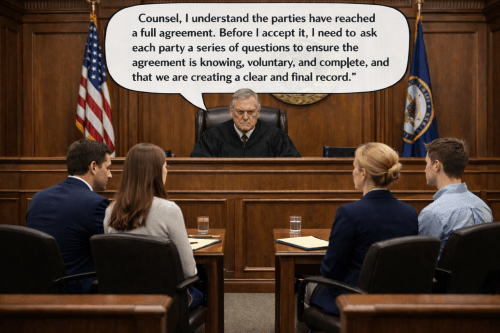
When parties appear in court to place a final divorce agreement on the record, Minnesota law does not require a formal on-the-record inquiry in every case. However, as a practical matter, the absence of a clear record can significantly increase the risk of a later motion to reopen based on claims of coercion, misunderstanding, or incomplete disclosure.

This Training Update focuses on what experienced judges and practitioners recognize as a judicial best practice: building a clear, thorough record that confirms the agreement is knowing, voluntary, fair, and based on full disclosure. While not mandated in all cases, this step is often the most effective way to protect the judgment’s finality and enforceability.

In this concise, 10-minute update, I outline:

  • When a hearing may not be required under Minnesota law, and when it is the wiser course to proceed on the record.
  • The practical risks of proceeding without a sufficient record.
  • And most importantly, a comprehensive, ready-to-use in-court script that judges and attorneys can use to create a complete and defensible record.

The script is designed to directly address the most common grounds for reopening under Minn. Stat. § 518.145, subd. 2, and to ensure the agreement will withstand later scrutiny.

You can access the full update here:

👉 Click here for a print-ready copy of Training Update 26-07

👉Click here to access Update 26-07 on the Minnesota Judicial Training and Education Website

If you handle family law matters, this is a practical tool you can use immediately to strengthen your cases and protect your clients.

Warm regards,
Alan F. Pendleton
Of Counsel, Martine Law Firm
Director of Mentorship and Education
Former District Court Judge
Top 10 Family Law Motion Rules Every Lawyer Must Know

New Martine Law Training Update on Family Law Motions – Ten Basic Rules Every Practitioner Should Know:


Family court motion practice is full of procedural landmines—miss a filing deadline, cite the wrong statute, or attach unsworn documents, and your argument may never be heard. Our latest Training Update cuts through the confusion with a clear and practical guide to the Ten Basic Rules of Family Law Motions.

Whether you’re filing for temporary relief, responding to a contempt motion, or preparing affidavits, this update will help you avoid the most common mistakes and improve your courtroom effectiveness.

📘 Highlights include:

  • How to avoid fatal service errors
  • What qualifies as a valid affidavit (and what doesn’t)
  • When courts must prioritize parenting time disputes under the new 2024 law
  • Why unsworn attachments can sink your motion
  • And much more.

Click here to read the full update: MLTU Family Law Motions – Ten Basic Rules (25-5).
Stay sharp, stay current—your clients (and the court) will thank you.

Special thanks to Martine Family Law attorneys Rhiley O’Rourke and Nicole Geffre for generously contributing their insight and expertise to this update.


NOTE: This training update is also available on the Minnesota Judicial Training and Education Website. While visiting, you can subscribe to receive notifications of new updates. Please share this training update with colleagues, clerks, or anyone who would benefit from staying current on Minnesota law and litigation strategy.


Martine Law Training Updates will continue to focus on key areas of litigation, including Criminal and Family Law, Evidence and Procedure, and Trial Advocacy. With a subscriber base exceeding 3,500 attorneys, judges, and legal professionals, these updates reflect our firm’s commitment to the belief that legal education is the heart of the judiciary.

GUARDIAN AD LITEM (GAL) REPORTS AND THE FOOL-PROOF HEARSAY TEST (13-08) [OUTDATED SEE NEW VERSION AT 20-01]

QUESTION: GAL reports usually contain “out of court statements” made by various third parties including the child(ren) at issue, such as “I saw daddy punch mommy in the face.” What legal analysis should the court follow if an attorney objects to the admissibility of such statements on hearsay grounds?

CLICK ON THE LINK BELOW TO READ MORE [This update is outdated. See new version at 20-01, dated March 31,2020]

Pendleton13.08-GAL_Reports-The_Fool-Proof_Hearsay_Test

Post Decree Motions to Modify Custody Based on Endangerment (13-03)

QUESTION: When Ruling on a Post-Decree Motion To Modify Custody (Based on a Claim of Endangerment) What is the “Rule of Nice-Petersen” and What 3-Step Analysis MUST the Court Follow?

CLICK ON BELOW LINK TO READ MORE

Pendleton Update 13-3

Parenting Time Expeditor vs. Parenting Consultant (12-01)

QUESTION: You Are Presiding Over A High Conflict Family Law Case With Numerous Parenting Time Disputes. You Would Like To Utilize The Services of A “Parenting Time Expeditor” or “Parenting Consultant” to Help Resolve those Disputes. What Is The Difference? 

CLICK ON LINK BELOW TO READ MORE

Pendleton12.01-Parenting_Time_Expeditor_vs_Parenting_Consultant

Rule 15 Type Questions to Finalize Divorce Proceedings (10-09)

QUESTION: WHAT ADDITIONAL INQUIRIES SHOULD THE COURT MAKE, WHEN DIVORCING PARTIES APPEAR IN COURT TO PUT THEIR FINAL AGREEMENT ON THE RECORD, TO PROTECT AGAINST EITHER PARTY SUBSEQUENTLY ASKING TO REOPEN THE CASE?

CLICK ON LINK BELOW TO READ MORE

Pendleton10.09-Rule_15_Type_Questions_to_Finalize_Divorce_Proceedings