Minnesota has enacted a significant overhaul of its firearm-surrender procedures. The new legislation, contained in Chapter 75, is long and complex—26 pages and more than 11,500 words—and is designed to establish a uniform statewide procedure for the surrender, transfer, documentation, storage, compliance, and return of firearms.
Because the law became effective August 1, 2026, judges and attorneys must understand these procedures now. Its impact extends across criminal, family, juvenile-protection, and pretrial-release proceedings and affects every major stakeholder in the justice system.
The attached Training Update, reduces this lengthy legislation to a practical, approximately 15-20 minute read. It explains:
the five statutory categories that may trigger a firearm-transfer order;
the difference between ordinary transfer, immediate law-enforcement possession, and forfeiture;
the permissible transfer options and special rules governing third-party transfers;
proof-of-compliance requirements and the mandatory compliance hearing;
enforcement, storage, return, and use-immunity provisions; and
the specific responsibilities of judges and attorneys at each stage of the process.
This is more than a technical revision. It substantially changes existing firearm-surrender practice and creates new responsibilities, deadlines, and potential consequences. I strongly encourage every judge, prosecutor, defense attorney, family-law attorney, and other legal-system professionals whose work may involve firearm restrictions to take the time to review this update.
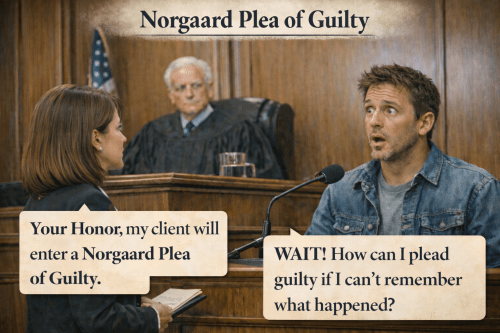
The Minnesota Supreme Court’s recent decision in State v. Steichen significantly clarifies the record that must be made before a district court may accept a Norgaard plea of guilty.
Our newest Minnesota Judicial Training Update explains the decision in practical terms and provides a step-by-step, in-court script that judges, prosecutors, and defense attorneys can use to create an adequate plea record.
The update focuses on the most important lesson from Steichen: it is no longer enough for the defendant simply to acknowledge reviewing the police reports and believing that a jury would likely convict. The record must include a meaningful description of the State’s actual trial evidence so the court can independently determine that the plea is supported by a strong factual basis.
The update takes less than 10 minutes to read and is designed to be kept readily available for use during a plea hearing. It includes:
The essential requirements of a valid Norgaard plea;
The prosecutor’s obligation to summarize the key evidence and connect it to the elements of the offense;
Questions for counsel and the court to ask the defendant; and
Suggested findings for the court to make before accepting the plea and adjudicating the defendant guilty.
I hope you find it useful both as a brief explanation of the Supreme Court’s decision and as a practical courtroom resource. Please feel free to forward it to colleagues who may benefit from it.
Search warrants are among the most common judicial acts in criminal law, but they are also among the easiest places for small mistakes to create significant constitutional problems.
This week’s Minnesota Judicial Training Update reviews ten search-warrant questions every judge and attorney should know, including:
the legal standard for probable cause,
the stricter statutory requirements for no-knock warrants,
nighttime searches,
who may issue and execute a warrant,
how modern electronic warrant applications are signed and submitted, and
what must be left at the scene and returned to the court after execution.
The update also includes practical reminders on issues that come up frequently in real cases:
confidential informants,
staleness,
out-of-county officers executing warrants,
the difference between telephonic and electronic warrants, and
the special nexus and particularity concerns that apply to phones, computers, cloud accounts, and digital extractions.
The goal is simple: to give judges, prosecutors, defense attorneys, and law enforcement officers a concise working checklist for getting search warrants right. A valid search warrant is more than a signed piece of paper. It is a constitutional safeguard, and understanding the basic rules helps everyone in the system do their job better.
I hope you find this update useful and worth sharing with colleagues who handle criminal cases, review warrant applications, or litigate search-and-seizure issues.
SUBJECT: Training Update: The 12-Month Probationary Jail Urban Myth.
Dear Colleagues:
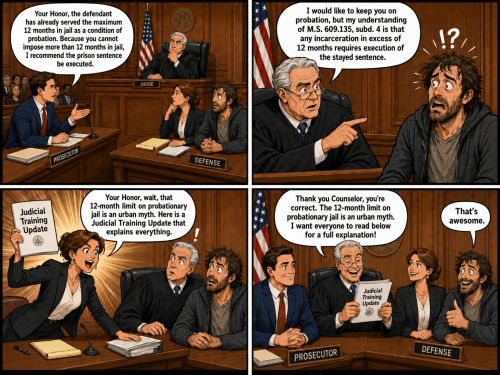
An urban myth has developed in Minnesota criminal practice regarding the amount of local jail time a district court may impose while a defendant is on probation.
The common misconception is that once a defendant has served a cumulative total of 12 months in jail as a condition of probation, the court has no authority to impose any additional jail time following a probation violation. Under this mistaken view, the court must execute the stayed prison sentence if further incarceration is warranted.
But the 12-month probationary jail rule does not operate that way.
This new Judicial Training Update is designed to clarify the urban myth, explain the important distinction between a per-sanction limit and a cumulative cap, and summarize the Minnesota appellate decisions that govern the issue.
This update can be read in approximately 5 to 10 minutes. As always, I hope you find this both helpful in your practice and useful in the courtroom. If it resonates with you, please feel free to share it with colleagues who may find it helpful.
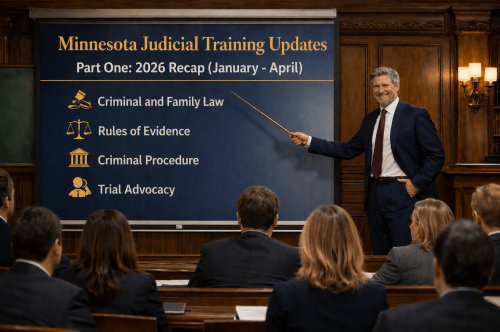
In the fast-paced practice areas of criminal law, family law, judicial procedure, and trial advocacy, staying current on new legal developments and effective courtroom strategy is essential. Since January 2026, seven training updates have been distributed addressing significant issues involving evidence, procedure, judicial best practices, and practical litigation guidance for Minnesota judges and attorneys.
With many new attorneys, judges, and legal professionals joining the distribution list each month, this recap serves as a single, consolidated reference for the first seven updates issued in 2026. Several of these updates address issues that arise regularly in Minnesota courtrooms and can create significant reversible error if overlooked.
Each update is also permanently available on the Minnesota Judicial Training and Education Blog. The most recent updates appear on the home page, while older updates are organized in a subject-matter index and a searchable keyword database.
The goal remains simple: practical training materials that help judges and attorneys avoid preventable error, make stronger records, and improve the quality of advocacy and judicial decision-making throughout Minnesota.
Title: AI-Based Legal Research: How to Avoid Hallucinations and Improve Accuracy
This training update addresses one of the fastest-growing risks facing attorneys: overreliance on AI-generated legal research without proper verification.
The central lesson is simple: do not trust AI like a research source—cross-examine it like an untested expert witness before you rely on it or cite it. The update provides a practical three-phase protocol for using AI safely, avoiding hallucinated cases, fake citations, and confidently incorrect legal analysis. It also addresses the ethics and competence implications under Rule 1.1.
Why it matters: AI can be a powerful legal assistant—but only if attorneys supervise it like one.
Title: Calculating Criminal History Scores: In-State vs. Out-of-State Convictions
This update focuses on a major sentencing landmine: proving out-of-state convictions for criminal history purposes.
Using State v. Johnson (2026), the update explains why a PSI alone is never enough under Minn. R. Evid. 1005, when certified conviction records are required, and how defense objections at sentencing can dramatically affect appellate remedies. This remains one of the most common avoidable sentencing errors.
Why it matters: A criminal history score error can significantly change a sentence—and often determines whether the defense wins on appeal.
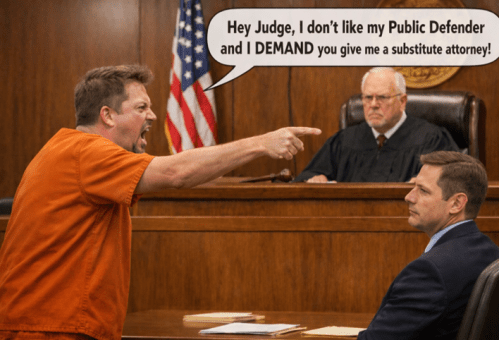
Title: Substitute Public Defenders: What the Trial Judge Must Do When a Defendant Demands New Counsel
Every judge and public defender eventually faces the angry defendant who demands a new attorney.
This update explains what courts must do—and what they must not do—when a defendant seeks substitute appointed counsel. It covers the required “searching inquiry,” exceptional circumstances, and common judicial mistakes that create reversible error, particularly when courts improperly defer the issue entirely to the Chief Public Defender.
Why it matters: Mishandling substitute-counsel requests creates unnecessary appeals and avoidable reversals.
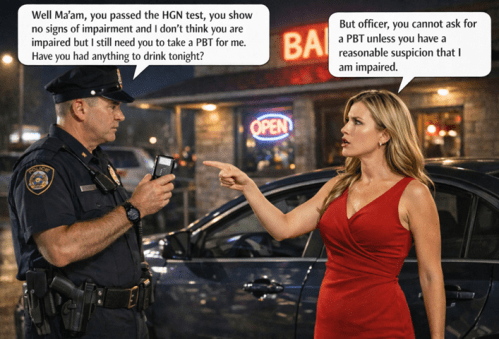
Title: “Reasonable Suspicion” After State v. Lorsung: What Every Judge and DWI Practitioner Needs to Know
This update analyzes one of the most important recent Minnesota DWI decisions.
The Minnesota Supreme Court clarified that the absence of classic signs of impairment—and even successful field sobriety performance—does not automatically eliminate reasonable suspicion for a preliminary breath test request. Lorsung significantly changes how courts should analyze reasonable suspicion in DWI and implied-consent cases.
Why it matters: This case will affect virtually every DWI practitioner in Minnesota.
Title: Felony Sentencings & Probation Violation Hearings: The One Thing a Judge Should Never Say
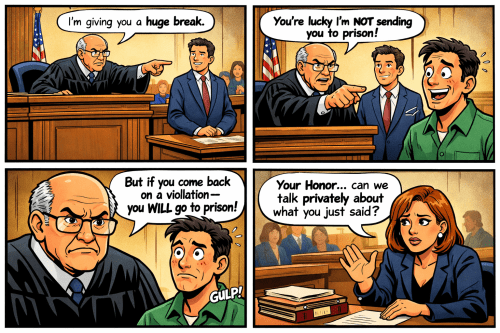
This update focuses on a surprisingly common but dangerous judicial mistake: telling a defendant, “If you violate probation again, you are going to prison.”
Under State v. Finch, statements like this may create disqualification problems because they suggest the court has prejudged the future probation violation hearing and the required Austin analysis. Judges may warn defendants—but they cannot promise revocation.
Why it matters: One poorly worded warning at sentencing can create a major appellate problem later.
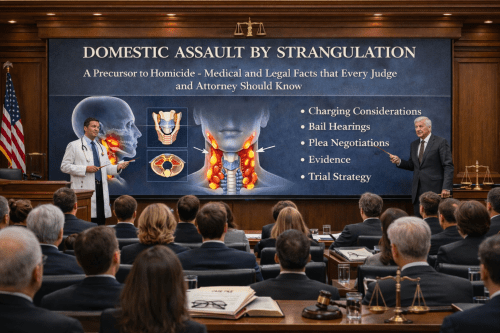
Title: Domestic Assault by Strangulation: Medical/Legal Facts Every Judge and Attorney Should Know
Strangulation cases remain among the most serious—and most misunderstood—domestic violence prosecutions.
This update explains why strangulation is one of the strongest predictors of future homicide, why visible injury is frequently absent, and why victim testimony alone may still be highly significant. It combines medical science, charging decisions, bail implications, evidentiary concerns, and trial strategy into one practical reference.
Why it matters: The absence of visible injury does not mean the absence of serious violence.
Title: Stipulated Divorce Settlement Agreements: How to Finalize the Agreement On-the-Record
This family law update focuses on one of the best opportunities to prevent future litigation: building a proper record when parties enter into a final divorce agreement.
The update explains the questions judges should ask before accepting a stipulated dissolution to reduce later motions to reopen based on coercion, misunderstanding, lack of disclosure, or claims that the agreement was not voluntary. The message is simple: if you would not be comfortable defending the agreement six months later, make the record today.
Why it matters: The best way to defend a future motion to reopen is to prevent it from succeeding in the first place.
If you missed any of the above updates, you can also access them at:
Want to search for past topics? Use the search bar, the Table of Contents, or the Subject Matter Index.
If you find this recap helpful, please consider forwarding it to colleagues, staff, or newer attorneys who may benefit. And if you have not already, visit the Minnesota Judicial Training and Education Blog to subscribe and receive future updates directly.
Special thanks to the Martine Law attorneys and staff who continue to contribute their insight and practical experience to these training updates.
Warm regards, Alan F. Pendleton Of Counsel, Martine Law Firm Director of Mentorship and Education Former District Court Judge
SUBJECT: Judicial Best Practice for Finalizing Divorce Agreements.
Dear Colleagues,
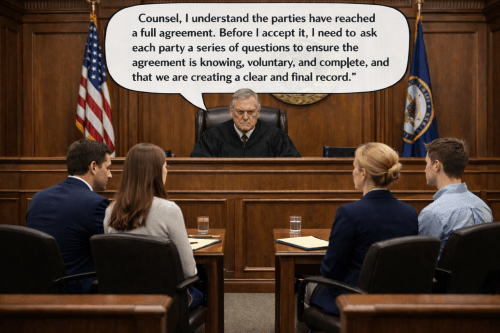
When parties appear in court to place a final divorce agreement on the record, Minnesota law does not require a formal on-the-record inquiry in every case. However, as a practical matter, the absence of a clear record can significantly increase the risk of a later motion to reopen based on claims of coercion, misunderstanding, or incomplete disclosure.
This Training Update focuses on what experienced judges and practitioners recognize as a judicial best practice: building a clear, thorough record that confirms the agreement is knowing, voluntary, fair, and based on full disclosure. While not mandated in all cases, this step is often the most effective way to protect the judgment’s finality and enforceability.
In this concise, 10-minute update, I outline:
When a hearing may not be required under Minnesota law, and when it is the wiser course to proceed on the record.
The practical risks of proceeding without a sufficient record.
And most importantly, a comprehensive, ready-to-use in-court script that judges and attorneys can use to create a complete and defensible record.
The script is designed to directly address the most common grounds for reopening under Minn. Stat. § 518.145, subd. 2, and to ensure the agreement will withstand later scrutiny.
Subject: A 10-Minute Update That May Change How You View Strangulation Cases
Dear Colleagues,
Strangulation cases are among the most dangerous—and most frequently misunderstood—cases that come before our courts.
What makes these cases particularly challenging is this: they often present with little or no visible injury, yet the underlying conduct may represent one of the strongest predictors of future homicide. That disconnect between appearance and reality can significantly affect charging decisions, bail determinations, plea negotiations, and trial strategy.
I have attached a concise, easy to read training update (10-minute read) that brings together key medical facts, Minnesota legal principles, and practical courtroom implications that every judge and attorney should understand when handling Domestic Assault by Strangulation cases.
This update focuses on a few critical takeaways:
Why lack of visible injury does not diminish the seriousness of the offense
How Minnesota law treats proof and corroboration in these cases
What these cases signal about future risk—and why that matters at bail and sentencing
Practical insights for both prosecutors and defense attorneys
This is one of those areas where a small shift in understanding can have a significant impact on outcomes—and potentially on victim safety.
As always, I hope you find this both helpful in your practice and useful in the courtroom. If it resonates with you, please feel free to share it with colleagues who might benefit.
Warm regards,
Alan F. Pendleton Of Counsel, Martine Law Firm Director of Mentorship and Education Former District Court Judge Minnesota Judicial Training & Education Blog
Let me start with a simple question: What is the one sentence a judge should never say at sentencing or a probation hearing?
If you’ve spent any time in a courtroom, you’ve probably heard some version of it—and perhaps even said it yourself.
This new training update takes a close look at a surprisingly common (and understandable) judicial instinct: trying to impress upon a defendant the seriousness of probation… and accidentally going a step too far. As the Minnesota Supreme Court made clear in State v. Finch, that one step can have real consequences, including disqualification of the judge from a future proceeding.
In this update, I break down:
• The one statement that crosses the line • Why the Austin analysis makes that statement improper • How this issue typically arises in real courtrooms (with examples we’ve all seen) • The 4 key takeaways from Finch every judge and attorney should know • A simple, practical way to fix the problem if it happens in your courtroom
And—true to form—you’ll also find a visual illustration that captures the moment perfectly (and may feel just a little too familiar).
This is one of those issues that is easy to overlook—but once you see it clearly, you’ll never miss it again.
As always, I hope you find this both helpful in your practice and useful in the courtroom. If it resonates with you, please feel free to share it with colleagues who might benefit.
Warm regards,
Alan F. Pendleton Of Counsel, Martine Law Firm Director of Mentorship and Education Former District Court Judge Minnesota Judicial Training & Education Blog
Subject: New Training Update: State v. Lorsung — “Reasonable Suspicion” After the Minnesota Supreme Court’s Latest DWI Decision.
Dear Colleagues,
Last month, the Minnesota Supreme Court issued an important decision in State v. Lorsung, clarifying what constitutes reasonable suspicion for an officer to request a preliminary breath test (PBT) during a DWI investigation.
The ruling may surprise many practitioners. In Lorsung, the driver admitted to drinking three beers but displayed no classic signs of impairment, spoke clearly, balanced normally, and even passed the HGN test with zero clues. The officer himself believed the driver did not appear impaired. Yet the Court still concluded that the officer had reasonable suspicion to request a PBT.
The decision significantly reshapes how courts will evaluate reasonable suspicion in DWI investigations. As the Court explains, the absence of traditional indicia of impairment — and even satisfactory roadside performance — may weaken suspicion but does not necessarily eliminate it unless the known facts “conclusively negate” the possibility of impairment.
This training update examines the Court’s reasoning, breaks down the case using the FIRAC method, and highlights several key takeaways that will directly affect suppression litigation, roadside investigations, and client counseling in DWI cases moving forward.
As always, I hope you find the update helpful. If you believe others in your office or professional network would benefit from it, please feel free to forward it along.
Warm regards,
Alan F. Pendleton Of Counsel, Martine Law Firm Director of Mentorship and Education Former District Court Judge Minnesota Judicial Training & Education Blog
SUBJECT: Training Update 26-03 – Substitute Public Defender Requests: Avoiding Reversible Error
Colleagues,
I have just posted a new Minnesota Judicial Training Update (26-03) addressing a situation every judge and criminal practitioner eventually encounters:
QUESTION: When a Defendant demands a new public defender in the middle of a criminal case, what is the trial judge legally required to do — and what common mistakes can create reversible error?
These moments often arise unexpectedly — usually at emotionally charged hearings — and they present real risk for reversible error if the court responds too quickly or relies on common but incorrect assumptions about substitute counsel requests.
This update provides a clear, practical framework designed for real courtroom use, including:
The three general rules that always apply under Minnesota law
What a judge should never say when a defendant requests new counsel
A structured three-step approach for handling the request on the record
The “searching inquiry” standard explained in practical terms
A sample judicial findings script that can be adapted immediately
The goal is simple: help judges and attorneys create a clean, reviewable record while maintaining courtroom control and protecting the integrity of the attorney-client relationship.
If you regularly handle criminal cases — whether as judge, prosecutor, or defense counsel — I think you will find this update both practical and immediately usable.
Message From Site Manager Alan Pendleton (former district court judge)
This training site contains the complete repository of "Judicial Training Updates". Training Updates are designed to be short, concise, easy-to-read judicial tips that every judge and attorney should know.
Judicial Training Updates are listed under TABLE OF CONTENTS and SUBJECT MATTER INDEX above and CATEGORIES below. The five most recent Updates are posted to the left.
JUDICIAL RESOURCE LIBRARY: This Blog also serves as a one-stop judicial resource library with hyperlinks to numerous legal research and reference sites.
NATIONAL RECOGNITION: From a field of more than 2,000 legal blogs, the Minnesota Judicial Training & Education Resource Center placed second in the highly competitive education category of the Expert Institute's Best Legal Blog National Competition.
ADD YOUR EMAIL BELOW AND RECEIVE A NOTIFICATION WHENEVER A NEW UPDATE IS POSTED.