Dear Colleagues,
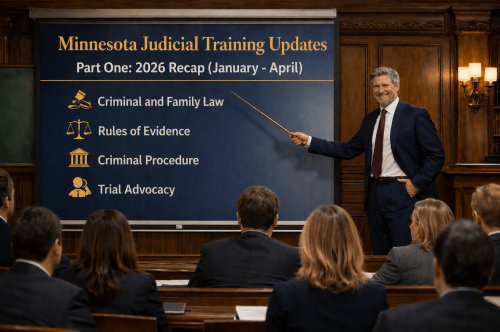
In the fast-paced practice areas of criminal law, family law, judicial procedure, and trial advocacy, staying current on new legal developments and effective courtroom strategy is essential. Since January 2026, seven training updates have been distributed addressing significant issues involving evidence, procedure, judicial best practices, and practical litigation guidance for Minnesota judges and attorneys.
With many new attorneys, judges, and legal professionals joining the distribution list each month, this recap serves as a single, consolidated reference for the first seven updates issued in 2026. Several of these updates address issues that arise regularly in Minnesota courtrooms and can create significant reversible error if overlooked.
Each update is also permanently available on the Minnesota Judicial Training and Education Blog. The most recent updates appear on the home page, while older updates are organized in a subject-matter index and a searchable keyword database.
The goal remains simple: practical training materials that help judges and attorneys avoid preventable error, make stronger records, and improve the quality of advocacy and judicial decision-making throughout Minnesota.
1. Training Update 26-01 (January 19, 2026)
Title: AI-Based Legal Research: How to Avoid Hallucinations and Improve Accuracy
This training update addresses one of the fastest-growing risks facing attorneys: overreliance on AI-generated legal research without proper verification.
The central lesson is simple: do not trust AI like a research source—cross-examine it like an untested expert witness before you rely on it or cite it. The update provides a practical three-phase protocol for using AI safely, avoiding hallucinated cases, fake citations, and confidently incorrect legal analysis. It also addresses the ethics and competence implications under Rule 1.1.
Why it matters: AI can be a powerful legal assistant—but only if attorneys supervise it like one.
2. Training Update 26-02 (February 2, 2026)
Title: Calculating Criminal History Scores: In-State vs. Out-of-State Convictions
This update focuses on a major sentencing landmine: proving out-of-state convictions for criminal history purposes.
Using State v. Johnson (2026), the update explains why a PSI alone is never enough under Minn. R. Evid. 1005, when certified conviction records are required, and how defense objections at sentencing can dramatically affect appellate remedies. This remains one of the most common avoidable sentencing errors.
Why it matters: A criminal history score error can significantly change a sentence—and often determines whether the defense wins on appeal.
3. Training Update 26-03 (February 19, 2026)
Title: Substitute Public Defenders: What the Trial Judge Must Do When a Defendant Demands New Counsel
Every judge and public defender eventually faces the angry defendant who demands a new attorney.
This update explains what courts must do—and what they must not do—when a defendant seeks substitute appointed counsel. It covers the required “searching inquiry,” exceptional circumstances, and common judicial mistakes that create reversible error, particularly when courts improperly defer the issue entirely to the Chief Public Defender.
Why it matters: Mishandling substitute-counsel requests creates unnecessary appeals and avoidable reversals.
4. Training Update 26-04 (March 5, 2026)
Title: “Reasonable Suspicion” After State v. Lorsung: What Every Judge and DWI Practitioner Needs to Know
This update analyzes one of the most important recent Minnesota DWI decisions.
The Minnesota Supreme Court clarified that the absence of classic signs of impairment—and even successful field sobriety performance—does not automatically eliminate reasonable suspicion for a preliminary breath test request. Lorsung significantly changes how courts should analyze reasonable suspicion in DWI and implied-consent cases.
Why it matters: This case will affect virtually every DWI practitioner in Minnesota.
5. Training Update 26-05 (March 20, 2026)
Title: Felony Sentencings & Probation Violation Hearings: The One Thing a Judge Should Never Say
This update focuses on a surprisingly common but dangerous judicial mistake: telling a defendant, “If you violate probation again, you are going to prison.”
Under State v. Finch, statements like this may create disqualification problems because they suggest the court has prejudged the future probation violation hearing and the required Austin analysis. Judges may warn defendants—but they cannot promise revocation.
Why it matters: One poorly worded warning at sentencing can create a major appellate problem later.
6. Training Update 26-06 (April 7, 2026)
Title: Domestic Assault by Strangulation: Medical/Legal Facts Every Judge and Attorney Should Know
Strangulation cases remain among the most serious—and most misunderstood—domestic violence prosecutions.
This update explains why strangulation is one of the strongest predictors of future homicide, why visible injury is frequently absent, and why victim testimony alone may still be highly significant. It combines medical science, charging decisions, bail implications, evidentiary concerns, and trial strategy into one practical reference.
Why it matters: The absence of visible injury does not mean the absence of serious violence.
7. Training Update 26-07 (April 23, 2026)
Title: Stipulated Divorce Settlement Agreements: How to Finalize the Agreement On-the-Record
This family law update focuses on one of the best opportunities to prevent future litigation: building a proper record when parties enter into a final divorce agreement.
The update explains the questions judges should ask before accepting a stipulated dissolution to reduce later motions to reopen based on coercion, misunderstanding, lack of disclosure, or claims that the agreement was not voluntary. The message is simple: if you would not be comfortable defending the agreement six months later, make the record today.
Why it matters: The best way to defend a future motion to reopen is to prevent it from succeeding in the first place.
If you missed any of the above updates, you can also access them at:
📚 Minnesota Judicial Training and Education Blog
Want to search for past topics? Use the search bar, the Table of Contents, or the Subject Matter Index.
If you find this recap helpful, please consider forwarding it to colleagues, staff, or newer attorneys who may benefit. And if you have not already, visit the Minnesota Judicial Training and Education Blog to subscribe and receive future updates directly.
Special thanks to the Martine Law attorneys and staff who continue to contribute their insight and practical experience to these training updates.
Warm regards,
Alan F. Pendleton
Of Counsel, Martine Law Firm
Director of Mentorship and Education
Former District Court Judge
May 6, 2026


