Are you confident your Minnesota “unable-to-recall” guilty pleas would survive appellate review?
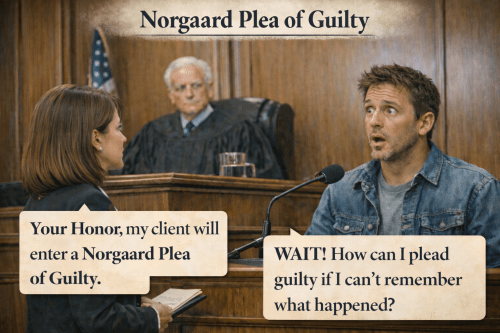
A Norgaard plea applies when a defendant wants to plead guilty (often for a plea bargain) but can’t recall the events due to intoxication or amnesia—and unlike an Alford plea, the defendant is not claiming innocence.
In this Martine Law Training Update, I break the procedure down into a practical three-step checklist and provide a ready-to-use in-court script that tracks the Norgaard Addendum (Rule 15, Appendix H)—so judges, prosecutors, and defense attorneys can make a complete record in real time.
👉 Click below for a print-ready copy of Training Update #25-12 (and keep the in-court script handy for your next plea hearing). Martine Law Training Update #25-12
Attached is my latest Martine Law Training Update, focused on a topic that continues to trip up even experienced attorneys and judges: the Alford plea.
Most of us rarely encounter these pleas—and that’s precisely when mistakes happen. A sloppy record can easily lead to reversal on appeal. This update does more than educate. It provides a clear, 3-step process that doubles as an in-court script to ensure that every Alford plea is entered properly, thoroughly, and—with confidence—appeal-proof.
Whether you’re a trial judge or trial attorney, this update gives you everything you need to handle an Alford plea correctly the next time it appears on your calendar.
As always, please feel free to forward this update to colleagues who may benefit from it. Thank you for continuing to make legal education part of your practice.
Special thanks to Martine Law attorneys Luke McClure and Kalen Best for generously contributing their insight and expertise to this update.
NOTE: This training update is also available on the Minnesota Judicial Training and Education Website. While visiting, you can subscribe to receive notifications of new updates. Please share this training update with colleagues, clerks, or anyone who would benefit from staying current on Minnesota law and litigation strategy.
Martine Law Training Updates will continue to focus on key areas of litigation, including Criminal and Family Law, Evidence and Procedure, and Trial Advocacy. With a subscriber base exceeding 3,500 attorneys, judges, and legal professionals, these updates reflect our commitment to the belief that legal education is the soul of the judiciary.
Warm regards, Alan F. Pendleton Of Counsel, Martine Law Firm Director of Mentorship and Education Former District Court Judge
QUESTION: Should a judge accept a plea of guilty when the factual basis supporting the plea of guilty is based on the common practice of asking defendants a series of leading questions, without the defendant ever stating in his own words what happened?
For the answer and explanation read the attached judicial training update.
NORGAARD PLEA OF GUILTY: A Norgaard Plea is a procedure that governs situations where a defendant wants to enter a plea of guilty (usually in order to take advantage of a plea agreement) but is unable to recall facts due to intoxication or amnesia. Unlike an Alford plea (see update 14-18) in a Norgaard plea, defendant does not make a claim he is innocent. State v. Ecker, 524 N.W.2d 712, 716 (Minn.1994); State v. Johnson, A14-1605, Minn. App. June 29, 2015.
To the dismay of the Court of Appeals, there are certain judicial mistakes/oversights that tend to reoccur with every new generation of judges and attorneys. Two of the most common oversights involve Alford and Norgaard pleas of guilty. These oversights almost always involve failure to make a complete record. Creating a full and complete record to support any plea of guilty should be viewed as a collaborative effort shared by both judge and attorneys.
The proper procedure for an Alford plea of guilty can be found in Update 14-18, dated October 8, 2014.
This week’s judicial update outlines the procedure that the district court must follow before a Norgaard plea of guilty can be accepted.
TO READ THE FULL UPDATE CLICK ON THE FOLLOWING LINK:
There are many conviction and sentencing factors that can have a dramatic impact on the deportation status of a non-citizen defendant. This update covers five of the most common problems that every judge and attorney should be aware of and one suggested best practice. The last page of the update includes references to several immigration services available to judges, attorneys and the general public.
Defendant pleads guilty to Felony Domestic Assault (but could be any criminal offense) pursuant to a plea agreement. Court accepts the plea, orders a PSI and return for sentencing. After reading the PSI court decides NOT to accept the plea agreement. At sentencing the court rejects the previously accepted plea of guilty. Defendant argues that his continued prosecution, following the rejection of a guilty plea that the district court had accepted in open court, violated the constitutional protection against double jeopardy.
QUESTION: WHAT IS A LOTHENBACH PLEA/STIPULATION? Unlike some other states, Minnesota does not allow a defendant to make a conditional guilty plea. Before the Lothenbach decision, in order to preserve the right to appeal a pre-trial issue even when no other material facts were in dispute, a criminal defendant was first required to plead “not guilty” and then go through an unnecessary jury trial. Recognizing this was inefficient, the Supreme Court created a procedure to preserve a defendant’s right to appeal a pre-trial order and avoid an otherwise unnecessary jury trial.
QUESTION: When attorneys ask or look to you for guidance on the type of sentence you are likely to impose, how do you protect yourself from impermissibly injecting yourself into plea negotiations?
QUESTION: Should judges accept a factual basis for a plea of guilty based on the common practice of asking defendants a series of leading questions, without the defendant ever stating in his own words what happened?
Message From Site Manager Alan Pendleton (former district court judge)
This training site contains the complete repository of "Judicial Training Updates". Training Updates are designed to be short, concise, easy-to-read judicial tips that every judge and attorney should know.
Judicial Training Updates are listed under TABLE OF CONTENTS and SUBJECT MATTER INDEX above and CATEGORIES below. The five most recent Updates are posted to the left.
JUDICIAL RESOURCE LIBRARY: This Blog also serves as a one-stop judicial resource library with hyperlinks to numerous legal research and reference sites.
NATIONAL RECOGNITION: From a field of more than 2,000 legal blogs, the Minnesota Judicial Training & Education Blog placed second in the highly competitive education category of the Expert Institute's Best Legal Blog National Competition.
ADD YOUR EMAIL BELOW AND RECEIVE A NOTIFICATION WHENEVER A NEW UPDATE IS POSTED.



 MINNESOTA JUDICIAL TRAINING & EDUCATION BLOG