Tag Archives: SENTENCING

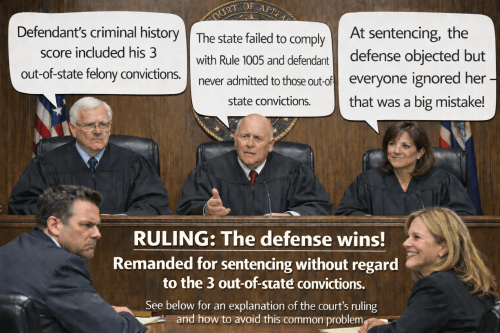
Calculating Criminal History Scores: In-State vs. Out-of-State Convictions (This is a Legal Landmine for Both the State and Defense)

SUBJECT: New Training Update: Out-of-State Convictions — A Sentencing Trap You Can’t Ignore

Dear Colleagues,

I’m sharing a new Martine Law Training Update addressing a deceptively common — and highly consequential — sentencing issue: how out-of-state convictions may (and may not) be used when calculating a defendant’s criminal history score.

In State v. Johnson (Minn. App. Jan. 20, 2026), the Court of Appeals makes clear that relying on a PSI alone to establish out-of-state convictions is a legal landmine. The case also delivers a critical lesson with real-world consequences: whether defense counsel objected at sentencing directly affected the remedy on appeal — including whether the State got a second chance to fix the record.

This update breaks down:

  • What Minn. R. Evid. 1005 requires (and what it doesn’t),
  • Why sentencing is an evidentiary determination, not a ministerial step,
  • How a single objection — or silence — can preserve or destroy appellate leverage,
  • Practical best practices for prosecutors, defense attorneys, and judges.

If you handle felony sentencing, review PSIs, advise clients at plea hearings, or preside over criminal cases, this is essential reading. I encourage you to read it, download it, and share it with colleagues who may not realize how high the stakes are until it’s too late.

The link to the full update is below.

Warm regards,
Alan F. Pendleton
Of Counsel, Martine Law Firm
Director of Mentorship and Education
Former Minnesota District Court Judge

RESTITUTION vs FINES – WHAT GETS PAID FIRST – NEW RULE (13-14)

QUESTION: If a defendant’s sentence includes both a fine and restitution, and if defendant makes one or more payments to court administration, what is payment first credited to – restitution or the fine?

CLICK ON LINK BELOW TO READ MORE

https://pendletonupdates.com/wp-content/uploads/2014/08/judicial-training-update-13-14.docx

FIVE IMMIGRATION FACTS EVERY JUDGE AND ATTORNEY SHOULD KNOW AND ONE SUGGESTED BEST PRACTICE (13-13) (OLD VERSION – SEE 13-13 DATED MARCH 7, 2014 FOR UPDATED VERSION)

There are many conviction and sentencing factors that can have a dramatic impact on the deportation status of a non-citizen defendant. This update covers five of the most common problems that every judge and attorney should be aware of.

CLICK ON LINK BELOW TO READ MORE

https://pendletonupdates.com/wp-content/uploads/2014/06/pendleton13-13-five_immigration_facts.pdf

Judicial Sentencing Oversight: Inadvertent Deprivation of Lawful Jail Credit (13-07)

When sentencing a defendant to prison, if the Court: 1) fails to state the number of jail credit days, or 2) the Court states the number of jail credit days but directs the prison to “verify” jail credit, the DOC will determine or verify jail credit by implementing a policy that does NOT allow credit for any time served other than ‘straight time’ (that includes denying jail credit for ‘work release’) even though defendants are lawfully entitled to such credit.

CLICK ON LINK BELOW TO READ MORE

Pendleton13.07-Judicial_Sentencing_Oversight

Jail Credit Calculation – New Supreme Court “Clarkin” Rule (12-07)

QUESTION: When The Court Imposes A Concurrent Sentence, Defendant Is Entitled To Jail Credit For All Time Spent In Custody In Connection With The Offense Being Sentenced Including Time Spent In Custody Related To Other Charges….BUT….How Do You Calculate The Starting Point For Jail Credit?

CLICK ON LINK BELOW TO READ MORE

Pendleton12.07-Jail_Credit_Calculation-New_Supreme_Court_Clarkin_Rule

District Court and Plea Negotiations – How Far is Too Far? (10-04)

QUESTION: When attorneys ask or look to you for guidance on the type of sentence you are likely to impose, how do you protect yourself from impermissibly injecting yourself into plea negotiations?

CLICK ON LINK BELOW TO READ MORE

Pendleton 10.04-District_Court_and_Plea_Negotiations-How_Far_is_Too_Far-Pendleton10.04

Felony Sentencing – 2 Common Misunderstandings (10-02)

QUESTION: When the district court commits a defendant to the commissioner of corrections (prison), does the court have authority to include a ‘no-contact’ order as part of the sentence, (for example: at the request of a terrified victim of a serious sexual or violent offense)?

CLICK ON LINK BELOW TO READ MORE

Pendleton 10.02-Felony_Sentencings-2_Common_Misunderstandings-Pendleton10.02