Category Archives: TRIAL ISSUES

PROSECUTORIAL MISCONDUCT: 15 Categories Every Judge and Attorney Should Recognize and Avoid (25-9)

Dear Colleagues,

Attached is our newest Martine Law Training Update, titled:
“Prosecutorial Misconduct: 15 Categories Every Attorney and Judge Should Recognize and Avoid”

This is one of the most comprehensive training updates I have produced to date. At 23 pages, it is designed not only as an informative resource but also as a statewide training tool for prosecutors, defense attorneys, and judges.

Although this update is titled Prosecutorial Misconduct, the focus is not on labels but on impact. Whether the conduct is characterized as error or misconduct matters less than the effect, because either, when serious enough, can deprive a defendant of a fair trial. Misconduct implies a deliberate or reckless violation; error may reflect an honest mistake. But both threaten the same outcome: injustice.

For that reason, this update does not attempt to parse whether a particular instance should be labeled “misconduct” or “error.” That distinction is best left to the appellate courts. Our focus here is practical: identifying improper prosecutorial conduct in all its forms so trial attorneys can recognize it, object to it, and preserve the issue for review.

The deeper concern, and the reason this update was created, is that these problems are not new. For decades, the Minnesota Supreme Court has made clear that prosecutors are not simply advocates seeking victory, but officers of justice with a duty to safeguard fairness—even when doing so weakens the State’s case. As the Court has long reminded us: “The prosecutor’s interest in a criminal prosecution is not that it shall win a case, but that justice shall be done.”

Despite this clear guidance, the same forms of misconduct continue to appear in trial records with troubling frequency. The problem is not a lack of clarity in the law—the rules are well-established—but a repeating generational pattern. Each new wave of prosecutors, eager to prove themselves in court, repeats the same mistakes made by those before them. The result is a predictable cycle: misconduct occurs, defense counsel objects, trial courts rule, and appellate courts issue yet another opinion restating principles that have been settled for decades. Most of these opinions today are nonprecedential, not because the law is unsettled, but because the errors are the same ones we have seen for generations.

This update is designed to help break that cycle. It sets out the 15 most common categories of prosecutorial misconduct seen in Minnesota courts, illustrated with leading cases, examples, and practice points. Together, these categories form a shared framework for all trial participants—prosecutors, defense attorneys, and judges—to recognize misconduct when it occurs, understand its significance, and take corrective action in real-time.

a) Prosecutors can use this update as an internal training tool to ensure advocacy remains effective while still within ethical boundaries.

b) Defense attorneys can use it to recognize misconduct as it occurs, object promptly, and preserve a clean record for appeal.

c) Judges can use it to guide intervention, remembering that the Minnesota Supreme Court has made clear that trial courts also bear responsibility for curbing misconduct—even when counsel fails to object.

The 15 Categories of Misconduct Covered in this Update:

  1. Shifting the Burden of Proof
  2. Injecting Issues Broader Than Guilt or Innocence
  3. Accusing Defendant of Tailoring Testimony
  4. Asking “Were They Lying” Questions
  5. Eliciting Inadmissible Evidence
  6. Misstating the Burden of Proof
  7. Misstating the Presumption of Innocence
  8. Expressing a Personal Opinion – Vouching
  9. Belittling the Defense
  10. Inflaming the Passions of the Jury
  11. Commenting on a Defendant’s Failure to Testify
  12. Misusing Spreigl Evidence
  13. Speculating About Events Absent a Factual Basis
  14. Eliciting Improper or Highly Prejudicial Testimony
  15. Injecting Self into Proceedings: “I,” “We,” “Me”

Importantly, these ethical limits do not require prosecutors to be bland, formulaic, or restrained in their passion. Minnesota courts have repeatedly affirmed that vigorous advocacy is entirely proper—so long as it remains grounded in admissible evidence and accurate law.

I encourage you to read and share this update with your colleagues. Whether you are a prosecutor, defense attorney, or judge, this resource is designed to promote more effective advocacy, fewer repeated mistakes, and a stronger commitment to justice and fairness in every courtroom.

You can read or download the full 23-page update here:
📄 Click here for Training Update 25-9 – Prosecutorial Misconduct


Special Thanks to Martine Law attorneys Luke McClure, Tyler Martin, Abbey Rostamo, and Kalen Best for generously contributing their insight and expertise to this update.

Acknowledgment: This update builds upon training materials first developed in 2005 by then–Assistant Hennepin County Attorneys Michael K. Walz, Jean E. Burdorf, and David C. Brown. Their work laid an important foundation for understanding the nature and scope of prosecutorial misconduct in Minnesota.


Martine Law Training Updates will continue to focus on key areas of litigation, including Criminal and Family Law, Evidence and Procedure, and Trial Advocacy. With a subscriber base of nearly 4,000 attorneys, judges, and legal professionals, these updates reflect our firm’s commitment to the belief that Legal Education is the Heart of the Judiciary. 

Warm regards,
Alan F. Pendleton
Of Counsel, Martine Law Firm
Director of Mentorship and Education
Former District Court Judge
alan@xmartinelaw.com
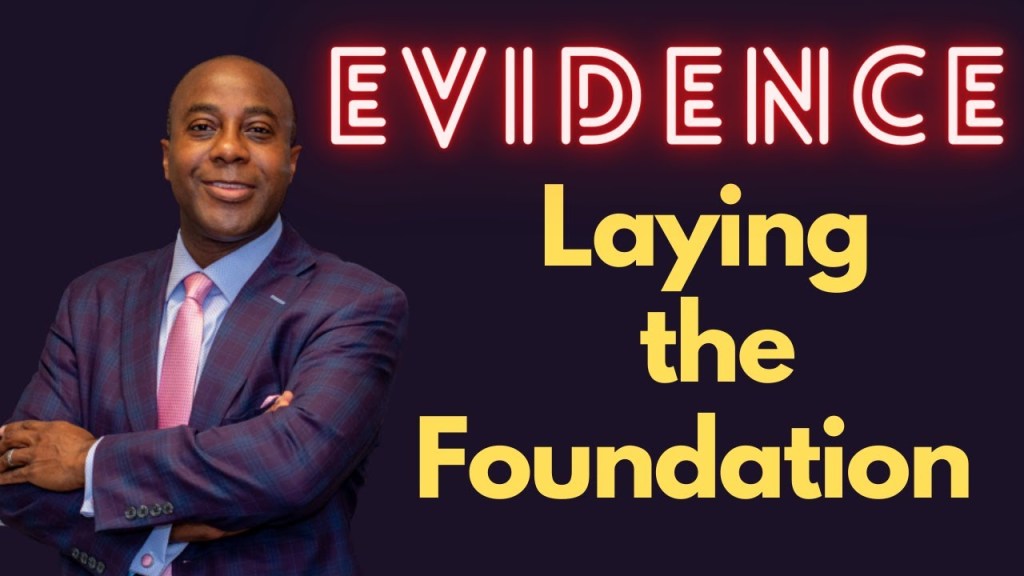
Laying the Proper Foundation for the Admission of Evidence: A Guide for Minnesota Trial Attorneys

Predicate Question Series #1

This training update is the first in a series that will focus on providing young trial attorneys with a sampling of predicate questions to help them improve their trial technique.

In Minnesota courts, one of the most essential skills for any trial attorney is the ability to lay the proper foundation. This foundation is necessary for the admission of evidence. This skill is crucial for success in trials. Under the Minnesota Rules of Evidence (MRE), attorneys must ensure that evidence is relevant, authentic, and reliable before it can be admitted. Failure to lay the proper foundation can result in the exclusion of critical evidence, potentially weakening your case.

What Does Laying the Proper Foundation Mean in Minnesota?

Laying the foundation in Minnesota courts refers to the process by which an attorney demonstrates to the court that a piece of evidence is admissible. This involves establishing facts that satisfy the court that the evidence is genuine, relevant to the case, and permissible under Minnesota law.

For example, to admit a document, an attorney must establish its authenticity by having a witness with personal knowledge testify that the document is what it purports to be (MRE 901). For other types of evidence, such as expert testimony, the attorney must show that the expert is qualified and that the testimony is based on reliable principles and methods (MRE 702).

Why Is This Skill Essential for Minnesota Trial Attorneys?

  • Avoiding the Exclusion of Critical Evidence: In Minnesota, evidence that lacks a proper foundation is subject to exclusion, which can significantly impair a case. For example, a failure to authenticate a crucial document or to establish an expert’s qualifications can result in the court excluding the evidence entirely. Mastering foundational requirements ensures that essential evidence is not lost due to procedural mistakes.
  • Navigating Objections Under Minnesota Rules: Proficiency in laying the foundation minimizes the chances of objections by opposing counsel. In Minnesota, objections to foundation can be made under various rules, such as MRE 602 (lack of personal knowledge) or MRE 403 (exclusion of evidence on grounds of prejudice, confusion, or waste of time). A strong foundation makes it difficult for opposing counsel to successfully challenge the admissibility of your evidence.
  • Increasing Courtroom Efficiency: Judges in Minnesota value efficiency and clear presentation of evidence. Young attorneys who can quickly and effectively lay the foundation for evidence demonstrate professionalism and competence. This not only streamlines the proceedings but also improves your standing in the courtroom.
  • Building Credibility with the Judge and Jury: The ability to skillfully lay the foundation enhances the attorney’s credibility before the court. When the judge and jury see that an attorney can efficiently admit evidence, it bolsters their confidence in the attorney’s case. This proficiency can also make the attorney’s argument more persuasive overall.
  • Preserving the Record for Appeal: Properly laying the foundation is essential for preserving the record in Minnesota courts. If evidence is excluded and the case is appealed, an appellate court will review the trial record. It will determine whether foundational requirements were met. An attorney who lays the foundation thoroughly can help ensure that any wrongful exclusion of evidence is reversed on appeal.
  • Understanding Minnesota-Specific Rules: The Minnesota Rules of Evidence, while similar to the Federal Rules of Evidence, have unique nuances. Attorneys must be familiar with these nuances. For example, MRE 104 allows the court to determine preliminary questions about the admissibility of evidence. Attorneys must be prepared to address these questions with facts and law specific to Minnesota precedent.

Providing Attorneys with a Sampling of Predicate Questions

This training update is the first in a series that will focus on providing young trial attorneys with a sampling of predicate questions that will help them improve their trial technique in three respects.

1. It will assist them in handling the evidence necessary to persuasively present their case to the judge or jury by getting helpful evidence admitted and keeping the harmful out;

2. It will help the less experienced attorneys capture the cadence of a trial, that quality of rhythm that permits an attorney to function smoothly and grammatically, setting the pace for the  events unfolding in the courtroom;

3. It will help perfect the record and protect it against the inevitable appeal that follows a vigorous and successful case.

Expertise in trial work comes only through the steady and diligent application of one’s legal skills to the courtroom setting. Experience alone is not enough. One must master both the technique and tactics of trial work. Only after one has mastered techniques can he apply himself to the subtleties of trial tactics. This series on trial predicate questions will, hopefully, help in achieving the mastery of trial advocacy.

In the same light, less experienced attorneys need to understand that these proposed predicate questions are only intended to serve as a starting point for individual trial attorneys. Attorneys should take, modify, or otherwise adapt the suggested foundational questions to conform with their local practice and the specific circumstances of their case.

Most older attorneys, as neophyte trial attorneys, remember when we wished we had access to a repository of predicate questions to draw upon when preparing our foundational questions. Hopefully, this predicate-question training series will serve as a repository for younger trial attorneys and perhaps a convenient refresher for more experienced attorneys.

Note: It should also be noted that all references to he, him, or Mr. should be interpreted to mean he/she, him/her, or Mr./ Ms. This format was adopted to maintain a focus on the content of the questions.

Conclusion

Learning how to properly lay the foundation for evidence under the Minnesota Rules of Evidence is crucial for Minnesota trial attorneys. This knowledge is essential to courtroom success. A strong foundation ensures that key evidence is admitted, helps avoid unnecessary objections, and maintains a clean record for appeal. Mastering this essential skill is vital in becoming a competent, persuasive trial lawyer in Minnesota courts.

NEXT UPDATE: Predicate Question Series #2 will focus on “Introduction of Physical Evidence”

Alan F. Pendleton, Attorney (former district court judge); Pendleton Legal Consulting Services, LLC; Minnesota Judicial Training & Education Blog; afpendleton@gmail.com

CRIMINAL JURY TRIAL JUDGES MANUAL “A Step by Step Guide From the Beginning of Trial Thru the Return of Verdict” (17-04)

Criminal Jury Trial Manual photo

In 2013 I published a Criminal Jury Trial Manual for Judges and Attorneys that covered every step of a Jury Trial from the pre-trial conference thru the return of verdict. It serves a dual purpose. For judges it serves as a step-by-step script that they can follow throughout the entire trial. For attorneys it serves as a trial reference guide and a reminder of key procedural issues that every trial attorney should know (but so many tend to forget or overlook.)  Whether you use the manual as a script or as a reference guide, following the recommended steps greatly reduces the risk of judge or attorney committing a costly mistake resulting in a mistrial or reversal on appeal. 

Back in 2013 copies of the manual were distributed to every District Court Judge, all 87 County Attorneys Offices, all 10 Judicial District Public Defender Offices, the Minnesota Supreme Court, the Court of Appeals, and dozens of private law firms and law libraries.

Even though a copy of the manual can be found on this Blog site, over the past year I have received so many requests for additional copies that I’ve decided to redistribute the manual via this post.

COPYRIGHT PERMISSION: Although the manual is copyrighted this post is your permission to download and distribute the manual to anyone you think might find it helpful. Click on link at bottom of this post.

For those unfamiliar with the manual, below is a copy of the Table of Contents.

(I) PRE-TRIAL CHECKLIST (IN CHAMBERS) ……………………………………………5
     1. SCHEDULING
     2. WITNESS LISTS
     3. SEQUESTRATION, EXCLUDING PERSONS, COURTROOM CLOSURE
     4. JURY INSTRUCTIONS – PRELIMINARY DISCUSSIONS
     5. CHARGES AND ARRAIGNMENT
     6. STIPULATIONS AND/OR ADMISSIONS
     7. JEOPARDY ATTACHES ONCE JURY SWORN – DEADLOCKED JURY – MISTRIAL
     8. DEFENDANT’S RIGHT NOT TO TESTIFY – PROPER RECORD
     9. DISCOVERY ISSUES
     10. AFFIRMATIVE DEFENSES
     11. WITNESS INCRIMINATION ISSUES
     12. SECURITY/CUSTODY ISSUES (IF DEFENDANT IN CUSTODY)
     13. USE OF WEAPONS/HAZARDOUS EXHIBITS DURING TRIAL
     14. OPENING STATEMENT
     15. EXHIBITS
     16. COMPETENCY OF CHILD WITNESSES – SAMPLE QUESTIONS
     17. PROSECUTORIAL MISCONDUCT
     18. MOTIONS IN LIMINE AND OTHER TRIAL EVIDENTIARY ISSUES
     19. VOIR DIRE PROCEDURES AND GUIDELINES
     20. TRIAL GROUND RULES
     21. JUDICIAL WIKIPEDIA – JUDGES ONLINE BENCH BOOK
II. START OF TRIAL AND VOIR DIRE…………………………………………………….20
     1. INTRODUCTION OF CASE (20)
     2. INSTRUCTIONS TO THE JURY PANEL BEFORE EMPANELMENT (20)
         a) Questions asked by the Court (23)
         b) Exercise of Preemptory Strikes (28)
         c) Cautionary Recess Instruction (29)
         d) Administration of Oath to Selected Jurors (30)
III. INSTRUCTIONS BEFORE TRIAL BEGINS………………………………………31
IV. EXPLAIN TRIAL PROCEDURE & OPENING STATEMENTS……………..39
V. ORDER OF TRIAL & CAUTIONARY INSTRUCTIONS ……………………….41
VI. FINAL JURY INSTRUCTIONS & CLOSING ARGUMENTS…………………42
VII. EXCUSE ALTERNATE & START OF DELIBERATIONS …………………….45
VIII. END OF TRIAL: REVIEW OF ADMITTED EXHIBITS …………………….46
IX. RETURN OF VERDICT…………………………………………………………………..47

The Manual can be viewed and downloaded by clicking on this link:

https://pendletonupdates.com/wp-content/uploads/2014/12/2013-criminal-jury-trial-judges-manual.pdf

Alan F. Pendleton, Former District Court Judge, afpendleton@gmail.com; 763-498-1508

EXPOSING IMPLICIT RACIAL BIAS DURING JURY SELECTION…HOW? (17-03)


IMPLICIT BIAS

Attorneys, judges and jurors all want to see themselves as fair, equitable, and rational, yet studies show that despite our best intentions none of us are free from bias. Implicit bias refers to unconsciously held biases that do not necessarily reflect our conscious beliefs.

Because implicit bias is subconscious, even people who consciously abhor discrimination can unconsciously be influenced by implicit bias. Studies show that implicit bias can affect how judges make decisions, how attorneys decide who to leave on juries and how jurors decide what testimony to believe or disregard.

The impact of implicit bias on decision making has been shown in numerous studies. For example:

  • Researchers sent identical resumes to employers and found a 50% drop in interview callback rates for the applicants when they changed the names on the resumes from Emily and Greg (signaling European ancestry) to Lakisha and Jamal (signaling African ancestry).
  • Study participants shown photos of black and white American men with neutral facial expressions perceived the black face to be more hostile than the white face, and the participant’s implicit bias as measured by the IAT correlated to the degree of hostility the participant perceived.
  • Partners reviewing the identical third-year associate memorandum rated the memorandum higher and found fewer errors when the associate was identified as white than black.

The important takeaway is not that implicit bias is bad or that people who have bias are bad people. We all have bias. Part of our job as trial attorneys and judges is to recognize and address racial justice issues whenever and wherever they arise.

For example, within the context of a jury trial, it is critically important to recognize the role that implicit racial bias may play within the minds of otherwise well intentioned jurors. But how do you uncover from someone a subconscious (implied) bias that the person’s conscious mind does not recognize or even realize exists. As Justice Sotamayor wrote: “The way to stop discrimination on the basis of race is to speak openly and candidly on the subject of race….”

The following are suggestions on how to introduce the issue of implicit racial bias to prospective jurors along with 15 carefully crafted voir dire questions.

IF RACE IS OR MAY BE AN ISSUE IN YOUR TRIAL CONSIDER THE FOLLOWING: 

During voir dire you have the right to question jurors concerning their beliefs and attitudes on race and racial bias. Start with introducing the issue of racial bias to the jurors and then try to get them to talk about it. Make sure to link questions about race to your case. The following statement to the jury panel and sample voir dire questions are a good starting point.

NOTE: Some attorneys may prefer to have the judge address the issue of racial bias with the jury panel by asking all or some of the following race related questions. All voir dire issues (including the racial bias statement below) should be discussed with the judge during your pretrial conference prior to commencement of trial.

INTRODUCING THE ISSUE OF RACIAL BIAS TO THE JURY PANEL: Ladies and gentlemen, despite the many differences in our lives and backgrounds, we all want to see ourselves as fair, equitable, and rational human beings, yet studies show that despite our best intentions none of us are free from bias. Implicit racial bias refers to unconsciously held biases that do not necessarily reflect our conscious beliefs. Because implicit bias is subconscious, even people who consciously abhor discrimination can unconsciously be influenced by implicit bias. Implicit bias is developed over the course of a lifetime through exposure to direct and indirect messages. Studies show that implicit bias can affect how we all make important decisions in our lives. Please keep that in mind as you answer the following questions

(Note: the following questions can also be found in the voir dire section of the Criminal Jury Trial Judges Manual):

  1. Please tell us the type of contacts you have had with Blacks/Asians/Native Americans/Hispanics
  2. Do you work with any Blacks/ Natives Americans/ Asians?
    1. Describe work setting i.e. large factory small office
    2. If so, do you socialize with them at work? Coffee breaks, lunch?
    3. Socialize with them outside of work? If so, types of activities?
    4. Have they been in your home? Have you been in their home?
  3. Do you have kids? Are they in school?
  4. Are your kid’s friends with any Blacks/Native Americans/ Asians in school?
  5. Have your kids’ minority friends ever been in your house?
  6. Have your kids ever been in their minority friend’s home?
  7. Do Blacks/ Native Americans/ Asians live in your neighborhood?
  8. Do you have any contact with them?
    1. Describe?
    2. Ever been in their house? They ever been in your house?
    3. Do your kids have any contact with them? Do their kids have any contact with you?
    4. Are you friends with them?
    5. Are their kids & your kids friends?
  9. Any Blacks/ Native Americans/ Asians in your church?
    1. If so, describe types of contacts you have with them?
  10. When you were growing up were there any Blacks/ Native Americans/ Asians in your neighborhood?
    1. What kind of relationship did you have with them?
    2. Describe activities you would do with them?
    3. They ever in your home? You ever in their home?
  11. Ever date Black/ Native American/ Asian?
    1. If yes, how did your parents feel about that?
  12. Have your children ever dated Black/ Native American/ Asian?
    1. If yes, how did you feel about that?
    2. If no, how would you feel about your child dating a Black/ Native American/ Asian?
  13. Have you or anyone close to you ever been the victim of a crime?
    1. Do you know the race/ethnicity of the person who committed that crime?
    2. If yes, is there anything about the race of the person who committed that crime that would make it difficult for you to be a juror in this case?
  14. Race can have no part in your deliberation and decision on the guilt or innocence of the Defendant. Do you understand and agree with that?
  15. Is there anything about the race of the Defendant in this case that would make it difficult for you to be a juror in this case?

JURY TRIAL REFERENCE TOOLS: For a “Complete Step-By-Step Guide from the Beginning of Trial through the Return of Verdict” go to the Criminal Jury Trial Judges Manual. If during voir dire the state or defense makes a peremptory strike on the basis of race or gender, every trial attorney (and judge) MUST be familiar with the 3 step BATSON challenge process. See Judicial Training Update “Jury Selection ‘Batson’ Challenge”. To access all past judicial training updates and the Judicial Resource Library, go to the Minnesota Judicial Training & Education Blog.   

IMPLICIT BIAS TEST: The most widely recognized test of implicit bias is the Implicit Association Test (IAT) conducted by Project Implicit a research website operated by Harvard University, Washington University, and the University of Virginia.

September 24, 2017

Alan F. Pendleton (Former District Court Judge)

afpendleton@gmail.com

763-498-1508

The “Rule of Primacy”, The Cornerstone to Effective Trial Advocacy: Plus Some Bonus Acting Tips (17-01)

rule-of-primacy

RULE OF PRIMACY: Following the “Rule of Primacy” is one of the easiest (yet most overlooked) ways for attorneys to improve their trial performance. If you’re a young attorney with aspirations of becoming the next Clarence Darrow you need to know and follow this rule (all great trial attorneys do). If you’re a presiding judge who believes in the value of mentoring young attorneys, the “Rule of Primacy” should be at the top of your constructive critique list to share with attorneys following a jury trial. So, what is the “Rule of Primacy”?

The most important concept to remember in organizing your statements to the jury, whether during opening statement or closing argument, is the “Rule of Primacy:” Jurors tend to believe what they hear first and most frequently.

What someone believes first is hard to change or dislodge. That’s why going first gives the prosecution in a criminal case or the plaintiff in a civil case a distinct advantage.

But regardless of whether you speak first to the jury, you can use these “Rule of Primacy” techniques to get them on your side:

Take advantage of your opening. The opening statement is made when jurors usually are the most attentive. Using a clear theme and reinforcing it with strong language chosen to produce a specific perception in the minds of jurors can help you persuade jurors even before presentation of the evidence. If a plaintiff gives a compelling opening statement, it’s absolutely imperative that the defense’s opening statement eliminate or minimize the effect of the rule of primacy. The task is made somewhat easier by the fact that jurors tend to forget much of what’s said to them. The defense opening should take advantage of the fact that what people do remember is what they hear at the beginning and end of a presentation.

Tell them what you are going to tell them; tell them; and then tell them what you’ve told them. This presentation organization is used by teachers with students and preachers with congregations. The trial format itself echoes these principles. The opening statement provides the first opportunity to “tell them what you are going to tell them.” Then, when you present the evidence, you do “tell them.” Finally, in closing argument, you “tell them what you’ve told them.”

Use opportunities for repetition when you get them. The opening statement and the closing argument should be used as vehicles for repetition. The use of repetition, along with strong, confident language selected for its most favorable emotional appeal, can be an extremely effective way to reinforce a party’s perspective in the eyes of the jurors. This is especially true when the same theories, facts, and phrases are used in the opening statement and closing argument. Jurors tend to remember and believe what they hear most often.

BONUS ACTING TIPS: Many years ago I took an acting class specifically designed for trial attorneys. During that class they stressed the importance of several simple yet effective techniques designed to help jurors remember key points raised during your opening statement and closing arguments. 

When presenting your opening statement or closing argument one of the WORST things you can do is plant yourself in one spot never moving more than 2 or 3 feet in any direction from your podium or your self-imposed spot on the floor.  REMEMBER: When preparing for trial you literally become the producer, writer, director, choreographer and actor of your own play. For purposes of this article I am focusing on your role as the “choreographer”. 

During a jury trial, the “WELL” section of the courtroom (the area in the center of the courtroom surrounded by the jury box, judge, witness stand and attorney tables) should be viewed as your performance stage, this is your moment in the sun, your moment of truth, this is where many close cases are won or lost…..YOU NEED TO USE AND MASTER THIS AREA – YOUR STAGE! But how? The answer is simple – you need to MOVE YOUR ASS. Use the space you have been given. Take advantage of every tool at your disposal. Don’t be a talking head…MOVE, MOVE, MOVE, but move with purpose and design. In other words, during your opening statement and/or closing argument, you must learn to choreograph your every move. FOR EXAMPLE:

1. FOCUS ON WITNESS: To highlight the testimony of a credible young sex abuse victim, you could walk to the witness stand where the young child sat while cringing with fear and embarrassment, and retell her story from that exact same spot (whether you stand by the witness chair or decide to sit in the chair is a matter of personal preference, and yes, there is no rule that says you can’t sit in the witness chair during portions of your summation). From the jurors perspective, your actions will automatically trigger powerful memories of the young child’s appearance and testimony. Or, for the defense, if the child victim was NOT credible or sympathetic, you could use the same technique to highlight the glaring inconsistencies brought out during your masterful cross-examination. 

2. FOCUS ON DEFENDANT: When you get to the part of your oratory masterpiece where you want to highlight some despicable act of the defendant, a key piece of evidence pointing to guilt, or perhaps his/her confession or incriminating statement, you could walk to where the defendant is sitting and dramatically point or gesture toward him/her. How physically close you get to the defendant and how far you go with the pointing or gesturing will depend on how aggressive you want to be and how far your judge will let you go. Or, for the defense, if you have a credible and sympathetic client, you can use this same technique to personalize your client by walking over to and gently placing your hands on his/her shoulders while you highlight  how horribly unfair the system has treated him/her.

3. THE KEY IS TO MOVE: There are a million variations to this theme….the point is to choreograph your opening and closings so that you make use of the courtroom stage. You accomplish that by moving and knowing exactly where in the courtroom you want to be standing (and why) when highlighting certain facts. Your presentation will be far more interesting and thus more effective and persuasive to the jury.

4. JURORS REMEMBERING MULTIPLE POINTS: Finally, what is the most effective way to maximize juror retention when you have 3 or 4 critically important facts you need the jurors to remember? Our brains are taught from an early age to read and retain information from left to right.                                                                                

When your about to discuss your first important point pick a spot to the right of the jury box (this is to your right – for jurors it will be to their left). Stay in that general area while discussing that first point.        

When your ready to move on to point two, move your spot a little to your left (which is the jurors right, the direction in which they read) and discuss your second point.

For your third point move to a spot a little further to your left (the jurors right), etc and etc. Jurors are watching and listening to your multiple points in the same direction that they would read a book. This provides mental separation between multiple points and allows jurors to subconsciously put a place holder of sorts on each point allowing for easy recall during the deliberation process.

Based on countless post-trial discussions I have had with jurors following the return of verdict, both as a judge and during my years as a prosecutor, I can tell you with absolute certainty that these simple techniques work.

You are limited only by the lack of your own imagination and willingness to move beyond your comfort zone. 

January 15, 2017

Alan F. Pendleton (Former District Court Judge), 763-498-1508; afpendleton@gmail.com

Source: CEBblog, Rule of Primacy, Julie Brook, January 13, 2017, State Bar of California.