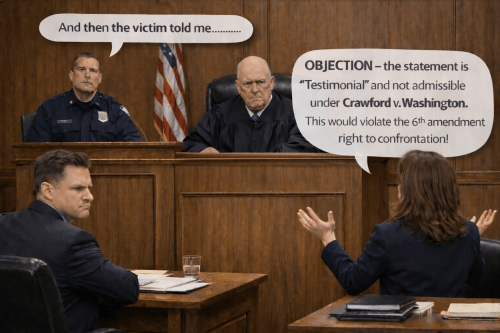
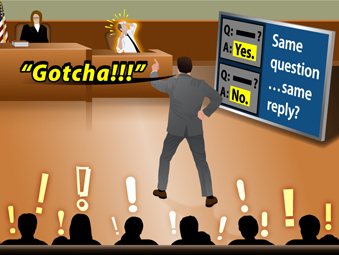
The hearsay rule permits the admission of many out-of-court statements, even when the declarant is unavailable for cross-examination and has never been subject to prior questioning. However, as established in the landmark decision Crawford v. Washington, 541 U.S. 36 (2004), the admission of certain statements, specifically those deemed testimonial, can present serious Sixth Amendment Confrontation Clause concerns that must be addressed before such evidence is allowed.
Crawford draws a critical distinction between non-testimonial hearsay (which does not implicate the Sixth Amendment) and testimonial hearsay (which does). When a hearsay statement is testimonial, and the declarant is unavailable and has not been subject to prior cross-examination, the Confrontation Clause prohibits its admission, regardless of its reliability or probative value.
Since Crawford, the central issue in Confrontation Clause jurisprudence has become: What exactly is “testimonial”?
QUESTION:
As a judge or trial attorney, how do you determine whether an out-of-court statement is “testimonial” and thereby triggers the defendant’s Sixth Amendment right to confrontation?
ANSWER:
The answer lies in applying a structured four-step analysis rooted in Crawford. This practical approach, accompanied by a user-friendly flowchart and checklist, guides you through the evaluation process to ensure compliance with constitutional standards.
NOTE: This update is also available on the Minnesota Judicial Training and Education Website. While visiting, you can subscribe to receive notifications of new updates. Please feel free to share this material with colleagues, clerks, or anyone who would benefit from staying current on Minnesota law and litigation strategy.
Going forward, Martine Law Firm Training Updates will continue to focus on key areas of litigation, including Criminal and Family Law, Evidence and Procedure, and Trial Advocacy. With a subscriber base approaching 3,500 attorneys, judges, and legal professionals, these updates reflect our firm’s commitment to the belief that legal education is the soul of the judiciary.
Thank you to the many colleagues and friends who have reached out with kind words and encouragement. For those who may not have heard, I recently joined the Martine Law Firm as Of Counsel and Director of Mentorship and Education. Martine is a dynamic, nine-attorney law firm with offices in Minnesota and North Carolina. Known for its rapid growth and strong courtroom presence, the firm focuses exclusively on Criminal Defense and Family Law.
Going forward, the Martine Law Training Updates will concentrate on core litigation areas including Criminal and Family Law, the Rules of Evidence and Procedure, and Trial Advocacy. Over the past year, the subscriber list has grown to nearly 3,500 attorneys, judges, and legal professionals. Because Martine Law is deeply committed to the principle that legal education is the soul of the judiciary, these updates will continue to be shared publicly as a resource to the bench and bar.
QUESTION: As a trial attorney, how can you determine whether an out-of-court statement is hearsay or non-hearsay?
ANSWER: If you have ever read “Alice in Wonderland,” you would be wise to follow the King’s advice to the white rabbit and always “begin at the beginning.” In other words, when dealing with the admissibility of an out-of-court statement, instead of assuming the statement is hearsay and skipping directly to the hearsay exceptions (which is what most of us do), it is always best to take a step back, go to the beginning and ask the threshold question: is this out-of-court statement really hearsay? The answer is not always clear. On closer examination, many statements that initially appear to be hearsay actually are not.
As a trial attorney, to make that determination, all you need to do is apply the following FOOL-PROOF HEARSAY TEST. This is a simple three-step test you can apply to any out-of-court statement.
To learn how to apply the Foolproof Hearsay Test, read the attached Martine Law Training Update.
NOTE: You can also read this training update on the Minnesota Judicial Training and Education Website. Once on the website, you can add your email and receive notifications whenever a new update is posted. Please distribute these training updates to anyone you believe could benefit from them.
This training update is the first in a series that will focus on providing young trial attorneys with a sampling of predicate questions to help them improve their trial technique.
In Minnesota courts, one of the most essential skills for any trial attorney is the ability to lay the proper foundation. This foundation is necessary for the admission of evidence. This skill is crucial for success in trials. Under the Minnesota Rules of Evidence (MRE), attorneys must ensure that evidence is relevant, authentic, and reliable before it can be admitted. Failure to lay the proper foundation can result in the exclusion of critical evidence, potentially weakening your case.
What Does Laying the Proper Foundation Mean in Minnesota?
Laying the foundation in Minnesota courts refers to the process by which an attorney demonstrates to the court that a piece of evidence is admissible. This involves establishing facts that satisfy the court that the evidence is genuine, relevant to the case, and permissible under Minnesota law.
For example, to admit a document, an attorney must establish its authenticity by having a witness with personal knowledge testify that the document is what it purports to be (MRE 901). For other types of evidence, such as expert testimony, the attorney must show that the expert is qualified and that the testimony is based on reliable principles and methods (MRE 702).
Why Is This Skill Essential for Minnesota Trial Attorneys?
Avoiding the Exclusion of Critical Evidence: In Minnesota, evidence that lacks a proper foundation is subject to exclusion, which can significantly impair a case. For example, a failure to authenticate a crucial document or to establish an expert’s qualifications can result in the court excluding the evidence entirely. Mastering foundational requirements ensures that essential evidence is not lost due to procedural mistakes.
Navigating Objections Under Minnesota Rules: Proficiency in laying the foundation minimizes the chances of objections by opposing counsel. In Minnesota, objections to foundation can be made under various rules, such as MRE 602 (lack of personal knowledge) or MRE 403 (exclusion of evidence on grounds of prejudice, confusion, or waste of time). A strong foundation makes it difficult for opposing counsel to successfully challenge the admissibility of your evidence.
Increasing Courtroom Efficiency: Judges in Minnesota value efficiency and clear presentation of evidence. Young attorneys who can quickly and effectively lay the foundation for evidence demonstrate professionalism and competence. This not only streamlines the proceedings but also improves your standing in the courtroom.
Building Credibility with the Judge and Jury: The ability to skillfully lay the foundation enhances the attorney’s credibility before the court. When the judge and jury see that an attorney can efficiently admit evidence, it bolsters their confidence in the attorney’s case. This proficiency can also make the attorney’s argument more persuasive overall.
Preserving the Record for Appeal: Properly laying the foundation is essential for preserving the record in Minnesota courts. If evidence is excluded and the case is appealed, an appellate court will review the trial record. It will determine whether foundational requirements were met. An attorney who lays the foundation thoroughly can help ensure that any wrongful exclusion of evidence is reversed on appeal.
Understanding Minnesota-Specific Rules: The Minnesota Rules of Evidence, while similar to the Federal Rules of Evidence, have unique nuances. Attorneys must be familiar with these nuances. For example, MRE 104 allows the court to determine preliminary questions about the admissibility of evidence. Attorneys must be prepared to address these questions with facts and law specific to Minnesota precedent.
Providing Attorneys with a Sampling of Predicate Questions
This training update is the first in a series that will focus on providing young trial attorneys with a sampling of predicate questions that will help them improve their trial technique in three respects.
1. It will assist them in handling the evidence necessary to persuasively present their case to the judge or jury by getting helpful evidence admitted and keeping the harmful out;
2. It will help the less experienced attorneys capture the cadence of a trial, that quality of rhythm that permits an attorney to function smoothly and grammatically, setting the pace for the events unfolding in the courtroom;
3. It will help perfect the record and protect it against the inevitable appeal that follows a vigorous and successful case.
Expertise in trial work comes only through the steady and diligent application of one’s legal skills to the courtroom setting. Experience alone is not enough. One must master both the technique and tactics of trial work. Only after one has mastered techniques can he apply himself to the subtleties of trial tactics. This series on trial predicate questions will, hopefully, help in achieving the mastery of trial advocacy.
In the same light, less experienced attorneys need to understand that these proposed predicate questions are only intended to serve as a starting point for individual trial attorneys. Attorneys should take, modify, or otherwise adapt the suggested foundational questions to conform with their local practice and the specific circumstances of their case.
Most older attorneys, as neophyte trial attorneys, remember when we wished we had access to a repository of predicate questions to draw upon when preparing our foundational questions. Hopefully, this predicate-question training series will serve as a repository for younger trial attorneys and perhaps a convenient refresher for more experienced attorneys.
Note: It should also be noted that all references to he, him, or Mr. should be interpreted to mean he/she, him/her, or Mr./ Ms. This format was adopted to maintain a focus on the content of the questions.
Conclusion
Learning how to properly lay the foundation for evidence under the Minnesota Rules of Evidence is crucial for Minnesota trial attorneys. This knowledge is essential to courtroom success. A strong foundation ensures that key evidence is admitted, helps avoid unnecessary objections, and maintains a clean record for appeal. Mastering this essential skill is vital in becoming a competent, persuasive trial lawyer in Minnesota courts.
NEXT UPDATE: Predicate Question Series #2 will focus on “Introduction of Physical Evidence”
Almost every GAL report I have ever read included statements made by the parties as well as the child(ren). Sometimes those statements can be extremely prejudicial, especially those made by young children (many of whom are too young or otherwise unable to testify in court).
Statements such as: “I saw daddy hit mommy in the face” or “daddy touches my privates late at night” or “I get mad at mommy because she leaves me home alone” or “when mommy gets really mad she slaps my face and it hurts”.
Because those type of statements could form the basis for charging a party with a criminal offense, many defense attorneys will vehemently demand those statements be stricken from the report arguing that they constitute inadmissible hearsay.
Whether you are a prosecutor or a Guardian Ad Litem, how do you plan on responding to the hearsay objection? And if you are the presiding judge what legal analysis do you apply to reach a proper ruling?
The attached Training Update answers all those questions and also provides prosecutors and Guardians with a sample in-court script to follow.
Greetings to all my cold Minnesota friends (cold hands but warm hearts). I’m writing this post from my winter home in Scottsdale, AZ where it’s currently a balmy 66 degrees. (sorry I couldn’t resist). Since writing my last update two months ago, I had tentatively decided to stop blogging and focus my attention on other endeavors. But something changed my mind.
The blog website recently crossed a historic threshold, 100,000 visits! When I started this online training service 3 years ago I never imagined it would ever reach the 100,000th mark. Use of the Resource Library hyperlinks have actually increased over the past year and new followers continue to subscribe to the blog site weekly. In addition to the search feature for all past training updates, the most popular website feature is the Judicial Resource Librarywith its numerous hyperlinks to various research and reference sites.
I decided that as long as there is continued use and interest in the blog site I will continue to post. So for this week’s post I return to my 2nd most favorite legal topic: Evidence.
Several years ago I wrote one of my most popular training updates and cover article for Bench & Bar magazine titled: “Admissibility of Electronic Evidence”. In that article I stated:
Due to the enormous growth in electronic correspondence, electronic writings (also known as e-evidence) have evolved into a fundamental pillar of communication in today’s society. Electronic communications have revolutionized how the world does business, learns about and shares news, and instantly engages with friends and family. Ninety one percent of today’s online adults use some form of electronic communication regularly in their everyday lives.1 Not surprisingly, various forms of electronic evidence (i.e., e-evidence) are increasingly being used in both civil and criminal litigation.
During trials, judges are often asked to rule on the admissibility of electronic evidence. How the court rules on questions of admissibility could substantially impact the outcome of a civil lawsuit or determine the difference between conviction or acquittal of a defendant. This unique form of evidence typically falls into one of five distinct categories: 1) Website Data; 2) Social Network Communications and Postings; 3) Email; 4) Text Messages; 5) Computer Stored/Generated Documents.
All of that is still true, but now there are many more social media platforms to consider. For example, Snapchat in particular has become a fertile source of evidence not to be overlooked.
Snapchat is a photo and video messaging app that’s different from other apps in that all photo and video messages on Snapchat (referred to as “snaps”) last for only a short amount of time and then disappear (but contrary to popular belief not permanently).
In his recentpost on Technologist,Casey Sullivan explained that because “much of a Snapchat user’s life is captured and transferred through the app, it has become an important source of evidence.”
For example, in July 2016 a man and a woman in Massachusetts were convicted of sexual assaultof a 16-year-old after they recorded the attack on Snapchat. Jurors were shown screenshots from the Snapchat video during the trial.
Snapchat’s speed filter, which lets users show how fast they’re going while taking a photo, was used as evidence in a Georgia caseinvolving a high-speed car crash. Plaintiffs sued both the driver and Snapchat, arguing that the speed filter encourages reckless drivingand can cause crashes. Snapchat’s speed filter alsomay have played a rolein a car crash that killed three young women.
And in an extremely macabre instance, a teenager from Jeanette, Pennsylvania posted aSnapchat selfie with a murder victim. That Snapchat photo became key evidence against him in his murder trial. Investigators told thePittsburgh Tribune Reviewthat the picture, screencapped by a recipient and shown to authorities, led to a search of defendant’s home, where police found the murder weapon in the defendants bedroom, a 9mm handgun. The 16-year-old defendant confessed to the murder.
It’s easy to imagine a myriad of cases in which Snapchat can be used as evidence. As Casey Sullivanput it, “[p]ersonal injury lawyers, divorce attorneys, criminal defense attorneys, and more could all benefit from evidence found through Snapchat.”
And the ephemeral nature of pictures on Snapchat isn’t necessarily a problem. Sullivanexplainsthat some Snapchat evidence is retained when users take screenshots of snaps and “Snapchat itself keeps logs of previous snaps.” But even deleted snaps don’t necessarily disappear;digital forensics expertscan still pull them from the phone.
Now that you know to look at Snapchat for evidence, what about getting that evidence admitted at trial? For a refresher on how to get social media evidence admitted, including the key hurdle of authentication, read my October 14, 2013 Bench & Bar article on “Admissibility of Electronic Evidence – Focus on Authenticity”or my 2013 training update on Electronic Evidence (13.11).
Try to stay warm.
Alan F. Pendleton (Former District Court Judge) New Email: afpendleton@gmail.com
Source: CEBblog, SnapChat as Evidence, Julie Brook, October 12, 2016, State Bar of California.
Message From Site Manager Alan Pendleton (former district court judge)
This training site contains the complete repository of "Judicial Training Updates". Training Updates are designed to be short, concise, easy-to-read judicial tips that every judge and attorney should know.
Judicial Training Updates are listed under TABLE OF CONTENTS and SUBJECT MATTER INDEX above and CATEGORIES below. The five most recent Updates are posted to the left.
JUDICIAL RESOURCE LIBRARY: This Blog also serves as a one-stop judicial resource library with hyperlinks to numerous legal research and reference sites.
NATIONAL RECOGNITION: From a field of more than 2,000 legal blogs, the Minnesota Judicial Training & Education Blog placed second in the highly competitive education category of the Expert Institute's Best Legal Blog National Competition.
ADD YOUR EMAIL BELOW AND RECEIVE A NOTIFICATION WHENEVER A NEW UPDATE IS POSTED.