
Category Archives: 2025 Martine Law Firm

WARRANTLESS ARRESTS & DETENTIONS: 36- & 48-Hour Rules

Dear Colleagues,

Attached is our newest Martine Law Training Update, titled:
“WARRANTLESS ARRESTS & DETENTIONS: 36 & 48 Hour Rules”

This update focuses on one of the most fundamental — and often misunderstood — aspects of criminal procedure: Minnesota’s 36- and 48-hour rules following an adult defendant’s arrest and continued detention. These rules are not technicalities; they are core constitutional safeguards that every judge and attorney should be able to calculate confidently and explain clearly to clients, law enforcement, and judicial officers.

This update is designed as a “Quick Attorney Reference Guide” and breaks the topic down into three practical questions:

(1) What is the 36-hour rule, and how is the time computed for warrantless arrests vs. arrests on a complaint/warrant?

(2) What is the 48-hour rule under County of Riverside v. McLaughlin and Minn. R. Crim. P. 4.03, and how does it interact with the 36-hour rule?

(3) What are the potential remedies when either rule is violated, including how the Wiberg factors and burdens of proof apply?

To help attorneys quickly calculate the 36- and 48-hour timeframes, this update includes easy-to-read visual charts that walk through real-world arrest scenarios day by day, making the 36- and 48-hour timing questions easy to see at a glance.

My hope is that you will review the attached update, print it or save it where you can reach it quickly, and consider sharing it with colleagues who handle bail, first appearances, or omnibus issues. A solid grasp of the 36- and 48-hour rules not only protects defendants’ rights but also helps judges and practitioners avoid potential violations that can derail otherwise strong cases.

As always, I welcome your comments, questions, and suggestions for future topics.

You can read or download the 5-page update here:
Click here for Training Update 25 – 11, Warrantless Arrests & Detentions: 36 & 48 Hour Rules


Special Thanks to Martine Law attorneys Tyler Martin, Abbey Rostamo, Kalen Best, Jude Jaber, Lizzy Cavanaugh, and Bruno Netto for generously contributing their insight and expertise to this update.


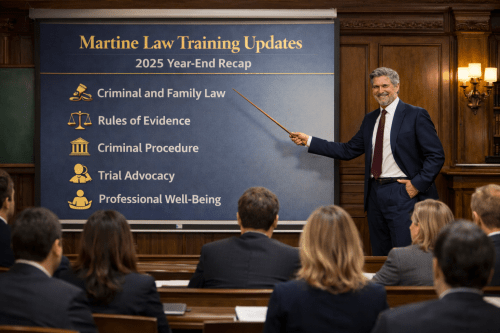
Martine Law Training Updates will continue to focus on key areas of litigation, including Criminal and Family Law, Evidence and Procedure, and Trial Advocacy. With a subscriber base of more than 4,000 attorneys, judges, and legal professionals, these updates reflect our firm’s commitment to the belief that Legal Education is the Heart of the Judiciary. 

Warm regards,
Alan F. Pendleton
Of Counsel, Martine Law Firm
Director of Mentorship and Education
Former District Court Judge


JUDICIAL & LEGAL WRITING – The Number One Rule for Improvement = CUTTING (25-10)

Dear Colleaques,

Attached is our newest Martine Law Training Update, titled: “JUDICIAL & LEGAL WRITING: The Number One Rule for Improvement = CUTTING.”

There are many books and articles dedicated to improving legal writing. Unfortunately, in many of these materials, you need an English degree to understand anything past the first paragraph. There is, however, a simple way to dramatically improve any style of legal writing that has nothing to do with dangling participles or misuse of pronouns, etc. Cutting unnecessary words is key to improving your writing.

Judges, attorneys, and other legal practitioners say the same thing about written legal submissions: they are too long. Most “legal writing” resources respond with lectures on grammar, style guides, and terminology that nobody has time to wade through. This Training Update takes a different approach. It focuses on one simple rule that will immediately improve every brief, motion, and email you write: cut unnecessary words.

Drawing on my experience reading thousands of briefs, motions, and emails from attorneys, I walk through concrete, before-and-after examples showing how to turn a bloated paragraph into something short, clear, and persuasive. The Update then breaks legal writing down into three practical levels—the sentence, the paragraph, and the final product—and gives you specific, easy-to-use techniques for each.

If you want your next submission to be easier for a judge to read, understand, and rule on, I encourage you to take a few minutes to read the full Training Update and share it with your colleagues and staff. A modest investment of time now will pay off in every brief you file going forward.


You can read or download the 3-page update here:
📄 Click here for Training Update 25-10: Judicial & Legal Writing


Martine Law Training Updates will continue to focus on key areas of litigation, including Criminal and Family Law, Evidence and Procedure, and Trial Advocacy. With a subscriber base of nearly 4,000 attorneys, judges, and legal professionals, these updates reflect our firm’s commitment to the belief that Legal Education is the Heart of the Judiciary. 

Warm regards,
Alan F. Pendleton
Of Counsel, Martine Law Firm
Director of Mentorship and Education
Former District Court Judge

Minnesota Judicial Training & Education Website

PROSECUTORIAL MISCONDUCT: 15 Categories Every Judge and Attorney Should Recognize and Avoid (25-9)

Dear Colleagues,

Attached is our newest Martine Law Training Update, titled:
“Prosecutorial Misconduct: 15 Categories Every Attorney and Judge Should Recognize and Avoid”

This is one of the most comprehensive training updates I have produced to date. At 23 pages, it is designed not only as an informative resource but also as a statewide training tool for prosecutors, defense attorneys, and judges.

Although this update is titled Prosecutorial Misconduct, the focus is not on labels but on impact. Whether the conduct is characterized as error or misconduct matters less than the effect, because either, when serious enough, can deprive a defendant of a fair trial. Misconduct implies a deliberate or reckless violation; error may reflect an honest mistake. But both threaten the same outcome: injustice.

For that reason, this update does not attempt to parse whether a particular instance should be labeled “misconduct” or “error.” That distinction is best left to the appellate courts. Our focus here is practical: identifying improper prosecutorial conduct in all its forms so trial attorneys can recognize it, object to it, and preserve the issue for review.

The deeper concern, and the reason this update was created, is that these problems are not new. For decades, the Minnesota Supreme Court has made clear that prosecutors are not simply advocates seeking victory, but officers of justice with a duty to safeguard fairness—even when doing so weakens the State’s case. As the Court has long reminded us: “The prosecutor’s interest in a criminal prosecution is not that it shall win a case, but that justice shall be done.”

Despite this clear guidance, the same forms of misconduct continue to appear in trial records with troubling frequency. The problem is not a lack of clarity in the law—the rules are well-established—but a repeating generational pattern. Each new wave of prosecutors, eager to prove themselves in court, repeats the same mistakes made by those before them. The result is a predictable cycle: misconduct occurs, defense counsel objects, trial courts rule, and appellate courts issue yet another opinion restating principles that have been settled for decades. Most of these opinions today are nonprecedential, not because the law is unsettled, but because the errors are the same ones we have seen for generations.

This update is designed to help break that cycle. It sets out the 15 most common categories of prosecutorial misconduct seen in Minnesota courts, illustrated with leading cases, examples, and practice points. Together, these categories form a shared framework for all trial participants—prosecutors, defense attorneys, and judges—to recognize misconduct when it occurs, understand its significance, and take corrective action in real-time.

a) Prosecutors can use this update as an internal training tool to ensure advocacy remains effective while still within ethical boundaries.

b) Defense attorneys can use it to recognize misconduct as it occurs, object promptly, and preserve a clean record for appeal.

c) Judges can use it to guide intervention, remembering that the Minnesota Supreme Court has made clear that trial courts also bear responsibility for curbing misconduct—even when counsel fails to object.

The 15 Categories of Misconduct Covered in this Update:

  1. Shifting the Burden of Proof
  2. Injecting Issues Broader Than Guilt or Innocence
  3. Accusing Defendant of Tailoring Testimony
  4. Asking “Were They Lying” Questions
  5. Eliciting Inadmissible Evidence
  6. Misstating the Burden of Proof
  7. Misstating the Presumption of Innocence
  8. Expressing a Personal Opinion – Vouching
  9. Belittling the Defense
  10. Inflaming the Passions of the Jury
  11. Commenting on a Defendant’s Failure to Testify
  12. Misusing Spreigl Evidence
  13. Speculating About Events Absent a Factual Basis
  14. Eliciting Improper or Highly Prejudicial Testimony
  15. Injecting Self into Proceedings: “I,” “We,” “Me”

Importantly, these ethical limits do not require prosecutors to be bland, formulaic, or restrained in their passion. Minnesota courts have repeatedly affirmed that vigorous advocacy is entirely proper—so long as it remains grounded in admissible evidence and accurate law.

I encourage you to read and share this update with your colleagues. Whether you are a prosecutor, defense attorney, or judge, this resource is designed to promote more effective advocacy, fewer repeated mistakes, and a stronger commitment to justice and fairness in every courtroom.

You can read or download the full 23-page update here:
📄 Click here for Training Update 25-9 – Prosecutorial Misconduct


Special Thanks to Martine Law attorneys Luke McClure, Tyler Martin, Abbey Rostamo, and Kalen Best for generously contributing their insight and expertise to this update.

Acknowledgment: This update builds upon training materials first developed in 2005 by then–Assistant Hennepin County Attorneys Michael K. Walz, Jean E. Burdorf, and David C. Brown. Their work laid an important foundation for understanding the nature and scope of prosecutorial misconduct in Minnesota.


Martine Law Training Updates will continue to focus on key areas of litigation, including Criminal and Family Law, Evidence and Procedure, and Trial Advocacy. With a subscriber base of nearly 4,000 attorneys, judges, and legal professionals, these updates reflect our firm’s commitment to the belief that Legal Education is the Heart of the Judiciary. 

Warm regards,
Alan F. Pendleton
Of Counsel, Martine Law Firm
Director of Mentorship and Education
Former District Court Judge
alan@xmartinelaw.com

Martine Law Training Update – 2025 Recap Issue Part-One

Dear Colleagues, in the fast-paced worlds of criminal and family law, staying current with recent legal developments, courtroom strategies, and practical tools is critical to effective advocacy. With hundreds of new attorneys, judges, and legal professionals joining our training distribution list every month, many may have missed important earlier updates.

To make access easier, this recap summarizes the last seven Martine Law Training Updates (25-2 through 25-8). Each update is available in full on the Minnesota Judicial Training and Education Website. The most recent five appear on the home page. Older updates are organized in a subject matter index, table of contents, and searchable keyword index. Please explore these resources and share them with others who may benefit.


1. Training Update 25-2 (April 27, 2025)

Title: Hearsay v. Non-Hearsay: The Fool-Proof Hearsay Test
This update introduces a 3-step analytical test for determining whether an out-of-court statement is hearsay. It emphasizes starting with the correct legal question — is the statement even hearsay? — before jumping to exceptions. It also outlines the six categories of Rule 801(d) non-hearsay statements and provides practical examples.
Why it matters: Avoiding hearsay errors at trial is a critical skill for litigators. This update gives attorneys a simple but powerful tool to analyze any out-of-court statement.
[Click here to read Training Update 25-2]


2. Training Update 25-3 (June 4, 2025)

Title: Crawford v. Washington and the Hearsay Testimonial Rule
This follow-up to Update 25-2 explains the “testimonial hearsay” rule under Crawford, Davis, and Krasky. It provides a four-part flowchart, primary purpose checklist, and sample motion to exclude testimonial hearsay.
Why it matters: Criminal defense attorneys must recognize and challenge testimonial hearsay violations to protect the client’s Sixth Amendment rights and preserve issues for appeal.
[Click here to read Training Update 25-3]


3. Training Update 25-4 (June 22, 2025)

Title: Marijuana Odor & Warrantless Vehicle Searches
This update breaks down the Minnesota Supreme Court’s ruling in State v. Torgerson (2023), and the new statute (M.S. 626.223) clarifying that the smell of marijuana alone does not justify a vehicle search. Also included: a practical guide to the 2023 Marijuana Reform Act and the “Open Cannabis Container” law (M.S. 169A.36).
Why it matters: Knowing what cannabis-related conduct is lawful vs. criminal is essential to properly challenge searches and suppress evidence.
[Click here to read Training Update 25-4]


4. Training Update 25-5 (July 7, 2025)

Title: Family Law Motions – Ten Basic Rules
This foundational update outlines ten core rules of family law motion practice, including service deadlines, scope of affidavits, oral testimony requests, GAL appointments, and unsworn attachments. It also highlights the new 2024 statutory requirement for expedited parenting time hearings under M.S. 518.131, Subd. 11.
Why it matters: These rules are often overlooked, but failure to follow them can result in canceled hearings, denied motions, or even professional embarrassment.
[Click here to read Training Update 25-5]


5. Training Update 25-6 (July 14, 2025)

Title: Dimler Amendment – Keeping Speeding Tickets Off the Driving Record
This update explains the application of the “Dimler Amendment” (M.S. 171.12, Subd. 6) which prevents certain low-level speeding violations from appearing on a person’s DPS driving record. It also covers practical strategies for asking for reduced speeds and amending tickets.
Why it matters: Understanding Dimler can protect clients from increased insurance rates, and gives defense attorneys negotiating leverage in traffic court.
[Click here to read Training Update 25-6]


6. Training Update 25-7 (July 21, 2025)

Title: Alford Pleas: A Three-Step Guide for Making a Valid Record
This update provides a complete procedural guide and sample script for accepting an Alford plea, including key questions to ask and how to make an appeal-proof record under State v. Theis and Goulette.
Why it matters: Improperly accepted Alford pleas can be reversed on appeal. This update ensures both prosecutors and defense attorneys make a clean, defensible record.
[Click here to read Training Update 25-7]


7. Training Update 25-8 (July 28, 2025)

Title: The Power of Gratitude: Transforming the Lives and Practices of Attorneys and Judges
Departing from the usual legal topics, this update addresses the mental health crisis in the legal profession and introduces gratitude as a science-backed practice to build resilience, reduce burnout, and foster better professional relationships.
Why it matters: Lawyers and judges in high-conflict fields like family and criminal law face extreme stress. This update provides a vital tool for long-term sustainability in the profession.
[Click here to read Training Update 25-8]


If you missed any of the above updates, you can also access them at:
📚 Minnesota Judicial Training and Education Website

Want to search for past topics? Use the search bar, the Table of Contents, or the Subject Matter Index.
New to our list? Welcome aboard — and thank you for your commitment to excellence in legal practice.

If you find this recap update helpful, please consider forwarding it to colleagues or staff who may benefit from it. And if you haven’t already, visit the Minnesota Judicial Training and Education Website to subscribe and receive future updates directly.

Special thanks to the Martine Law attorneys and Paralegals who generously contributed their insight and expertise to all past training updates.


Martine Law Training Updates will continue to focus on key areas of litigation, including Criminal and Family Law, Evidence and Procedure, and Trial Advocacy. With a subscriber base approaching 4000 attorneys, judges, and legal professionals, these updates reflect our firm’s commitment to the belief that legal education is the soul of the judiciary.

Warm regards,
Alan F. Pendleton
Of Counsel, Martine Law Firm
Director of Mentorship and Education
Former District Court Judge

The Power of Gratitude: Transforming the Lives of Attorneys and Judges

Dear Colleagues,

Training Updates are designed to be short, concise, easy-to-read judicial tips that every judge and attorney should know. Because the majority of our 3500+ subscriber base consists of attorneys and judges, these training updates will continue to focus on key areas of litigation, particularly Criminal and Family Law, Rules of Evidence and Procedure, and Trial Advocacy.

However, from time to time, it is important to focus on topics that speak to the personal side of legal practice — especially the importance of maintaining a healthy work-life balance. That is the focus of this week’s update.

In the high-stress world of criminal and family law, we are constantly surrounded by conflict, urgency, and emotional strain. Whether you’re in the courtroom, the office, or supporting attorneys behind the scenes, the pressure never lets up — and the toll it takes is real. Burnout, fatigue, and compassion depletion are not just risks — they are common outcomes in our profession.

This Martine Law Training Update focuses on a concept that is often overlooked in legal circles but backed by solid science: gratitude. Far from being a soft or sentimental idea, gratitude is one of the most effective, research-supported tools we have to reduce stress, improve resilience, and restore a sense of balance in both our personal and professional lives.

Gratitude literally rewires the brain. It sharpens your thinking, strengthens your relationships, and helps you respond to stress with more clarity and control. For attorneys, judges, paralegals, and legal staff, practicing gratitude is not just beneficial — it’s essential for long-term sustainability in a high-stakes practice environment.

This update offers a fresh, science-backed approach to managing the emotional toll of litigation, something every criminal and family law professional can benefit from.

You can read or download the full update here:
📄 Click here for Training Update 25-8 – The Power of Gratitude


If you find this update helpful, please consider forwarding it to colleagues or staff who may benefit from it. And if you haven’t already, visit the Minnesota Judicial Training and Education Website to subscribe and receive future updates directly.

Special thanks to Martine Law Paralegals Autumn Amick and Brian Louis for generously contributing their insight and expertise to this update.


Martine Law Training Updates will continue to focus on key areas of litigation, including Criminal and Family Law, Evidence and Procedure, and Trial Advocacy. With a subscriber base exceeding 3,500 attorneys, judges, and legal professionals, these updates reflect our firm’s commitment to the belief that legal education is the soul of the judiciary.

Warm regards,
Alan F. Pendleton
Of Counsel, Martine Law Firm
Director of Mentorship and Education
Former District Court Judge

alan@xmartinelaw.com