
Monthly Archives: June 2025

New Marijuana Law Training Update: What Every Minnesota Judge and Attorney Should Know

Dear Colleagues,

Minnesota’s marijuana laws have undergone sweeping changes—and the legal consequences for misapplying them can be severe. In our latest Martine Law Training Update (25-4), we unpack the most pressing and misunderstood issue in current search-and-seizure law:

Does the smell of marijuana alone still give officers probable cause to search a vehicle?
The Minnesota Supreme Court says no — and the Legislature has now codified that ruling into law.


This update dives into:

  1. The core holding of State v. Torgerson and how it reshapes warrantless vehicle search analysis
  2. Ten key facts from the 2023 Marijuana Reform Act
  3. How M.S. 169A.36 makes even trace THC in a vehicle a prosecutable offense—including legal hemp edibles and medical cannabis

Whether you practice criminal law, handle suppression issues, or just want to avoid costly legal missteps, this update is essential reading. Judges, prosecutors, and defense counsel alike must understand where the constitutional lines are drawn and how the marijuana reform laws interact with existing vehicle and drug statutes.

Click here for a print-ready copy of Martine Law Training Update 2025-4


NOTE: This training update is also available on the Minnesota Judicial Training and Education Website. While visiting, you can subscribe to receive notifications of new updates. Please share this training update with colleagues, clerks, or anyone who would benefit from staying current on Minnesota law and litigation strategy.


Martine Law Training Updates will continue to focus on key areas of litigation, including Criminal and Family Law, Evidence and Procedure, and Trial Advocacy. With a subscriber base approaching 3,500 attorneys, judges, and legal professionals, these updates reflect our firm’s commitment to the belief that legal education is the soul of the judiciary.
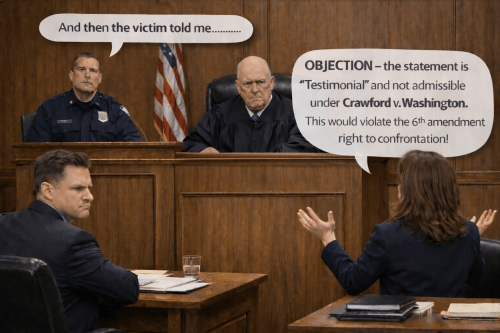

Crawford v. Washington and the Hearsay Testimonial Rule: Protecting the Defendant’s 6th Amendment Right to Confrontation


INTRODUCTION TO CONFRONTATION CLAUSE ISSUES

The hearsay rule permits the admission of many out-of-court statements, even when the declarant is unavailable for cross-examination and has never been subject to prior questioning. However, as established in the landmark decision Crawford v. Washington, 541 U.S. 36 (2004), the admission of certain statements, specifically those deemed testimonial, can present serious Sixth Amendment Confrontation Clause concerns that must be addressed before such evidence is allowed.

Crawford draws a critical distinction between non-testimonial hearsay (which does not implicate the Sixth Amendment) and testimonial hearsay (which does). When a hearsay statement is testimonial, and the declarant is unavailable and has not been subject to prior cross-examination, the Confrontation Clause prohibits its admission, regardless of its reliability or probative value.

Since Crawford, the central issue in Confrontation Clause jurisprudence has become: What exactly is “testimonial”?


QUESTION:

As a judge or trial attorney, how do you determine whether an out-of-court statement is “testimonial” and thereby triggers the defendant’s Sixth Amendment right to confrontation?

ANSWER:

The answer lies in applying a structured four-step analysis rooted in Crawford. This practical approach, accompanied by a user-friendly flowchart and checklist, guides you through the evaluation process to ensure compliance with constitutional standards.

To access the complete explanation, flowchart, and checklist, read the attached Martine Law Firm Training Update 25-3.

For a print-ready version, click here.


NOTE: This update is also available on the Minnesota Judicial Training and Education Website. While visiting, you can subscribe to receive notifications of new updates. Please feel free to share this material with colleagues, clerks, or anyone who would benefit from staying current on Minnesota law and litigation strategy.


Going forward, Martine Law Firm Training Updates will continue to focus on key areas of litigation, including Criminal and Family Law, Evidence and Procedure, and Trial Advocacy. With a subscriber base approaching 3,500 attorneys, judges, and legal professionals, these updates reflect our firm’s commitment to the belief that legal education is the soul of the judiciary.