Tag Archives: Hearsay

Crawford v. Washington and the Hearsay Testimonial Rule: Protecting the Defendant’s 6th Amendment Right to Confrontation


INTRODUCTION TO CONFRONTATION CLAUSE ISSUES

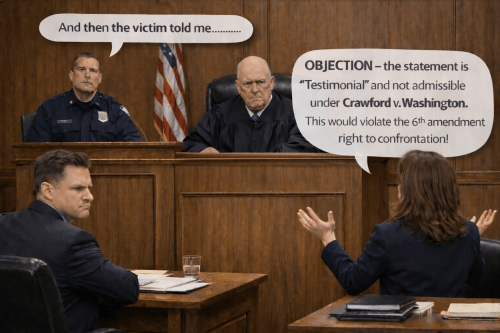
The hearsay rule permits the admission of many out-of-court statements, even when the declarant is unavailable for cross-examination and has never been subject to prior questioning. However, as established in the landmark decision Crawford v. Washington, 541 U.S. 36 (2004), the admission of certain statements, specifically those deemed testimonial, can present serious Sixth Amendment Confrontation Clause concerns that must be addressed before such evidence is allowed.

Crawford draws a critical distinction between non-testimonial hearsay (which does not implicate the Sixth Amendment) and testimonial hearsay (which does). When a hearsay statement is testimonial, and the declarant is unavailable and has not been subject to prior cross-examination, the Confrontation Clause prohibits its admission, regardless of its reliability or probative value.

Since Crawford, the central issue in Confrontation Clause jurisprudence has become: What exactly is “testimonial”?


QUESTION:

As a judge or trial attorney, how do you determine whether an out-of-court statement is “testimonial” and thereby triggers the defendant’s Sixth Amendment right to confrontation?

ANSWER:

The answer lies in applying a structured four-step analysis rooted in Crawford. This practical approach, accompanied by a user-friendly flowchart and checklist, guides you through the evaluation process to ensure compliance with constitutional standards.

To access the complete explanation, flowchart, and checklist, read the attached Martine Law Firm Training Update 25-3.

For a print-ready version, click here.


NOTE: This update is also available on the Minnesota Judicial Training and Education Website. While visiting, you can subscribe to receive notifications of new updates. Please feel free to share this material with colleagues, clerks, or anyone who would benefit from staying current on Minnesota law and litigation strategy.


Going forward, Martine Law Firm Training Updates will continue to focus on key areas of litigation, including Criminal and Family Law, Evidence and Procedure, and Trial Advocacy. With a subscriber base approaching 3,500 attorneys, judges, and legal professionals, these updates reflect our firm’s commitment to the belief that legal education is the soul of the judiciary.

HEARSAY vs. NON-HEARSAY: The Foolproof Hearsay Test

Thank you to the many colleagues and friends who have reached out with kind words and encouragement. For those who may not have heard, I recently joined the Martine Law Firm as Of Counsel and Director of Mentorship and Education. Martine is a dynamic, nine-attorney law firm with offices in Minnesota and North Carolina. Known for its rapid growth and strong courtroom presence, the firm focuses exclusively on Criminal Defense and Family Law.

Going forward, the Martine Law Training Updates will concentrate on core litigation areas including Criminal and Family Law, the Rules of Evidence and Procedure, and Trial Advocacy. Over the past year, the subscriber list has grown to nearly 3,500 attorneys, judges, and legal professionals. Because Martine Law is deeply committed to the principle that legal education is the soul of the judiciary, these updates will continue to be shared publicly as a resource to the bench and bar.

QUESTION: As a trial attorney, how can you determine whether an out-of-court statement is hearsay or non-hearsay?

ANSWER: If you have ever read “Alice in Wonderland,” you would be wise to follow the King’s advice to the white rabbit and always “begin at the beginning.” In other words, when dealing with the admissibility of an out-of-court statement, instead of assuming the statement is hearsay and skipping directly to the hearsay exceptions (which is what most of us do), it is always best to take a step back, go to the beginning and ask the threshold question: is this out-of-court statement really hearsay? The answer is not always clear. On closer examination, many statements that initially appear to be hearsay actually are not.

As a trial attorney, to make that determination, all you need to do is apply the following FOOL-PROOF HEARSAY TEST. This is a simple three-step test you can apply to any out-of-court statement.

To learn how to apply the Foolproof Hearsay Test, read the attached Martine Law Training Update.

For a print-ready copy of training update 25-2, click here.

NOTE: You can also read this training update on the Minnesota Judicial Training and Education Website. Once on the website, you can add your email and receive notifications whenever a new update is posted. Please distribute these training updates to anyone you believe could benefit from them.

ADMISSIBILITY OF GUARDIAN AD LITEM (GAL) REPORTS: How to overcome hearsay objections (20-01)

Almost every GAL report I have ever read included statements made by the parties as well as the child(ren). Sometimes those statements can be extremely prejudicial, especially those made by young children (many of whom are too young or otherwise unable to testify in court).

Statements such as: “I saw daddy hit mommy in the face” or “daddy touches my privates late at night” or “I get mad at mommy because she leaves me home alone” or “when mommy gets really mad she slaps my face and it hurts”.

Because those type of statements could form the basis for charging a party with a criminal offense, many defense attorneys will vehemently demand those statements be stricken from the report arguing that they constitute inadmissible hearsay.

Whether you are a prosecutor or a Guardian Ad Litem, how do you plan on responding to the hearsay objection? And if you are the presiding judge what legal analysis do you apply to reach a proper ruling?

The attached Training Update answers all those questions and also provides prosecutors and Guardians with a sample in-court script to follow.

Click here for a print ready copy of Update 2020-1

Please feel free to share this update with other prosecutors, guardians or judges that might benefit from it.

ADMISSIBILITY OF BUSINESS RECORDS – FIVE QUESTIONS THAT MUST BE ANSWERED – Rule 803(6) (14-02)

DURING TRIAL: When A Party Offers Documents Into Evidence Under The Business Records Hearsay Exception (rule 803(6)) What Five Questions Should The Court Answer Before Ruling on Admissibility? (This assumes the documents are, in fact, business records, are relevant and not privileged.)

CLICK LINK BELOW TO READ MORE

Pendleton Update 14-2