Let me start with a simple question: What is the one sentence a judge should never say at sentencing or a probation hearing?
If you’ve spent any time in a courtroom, you’ve probably heard some version of it—and perhaps even said it yourself.
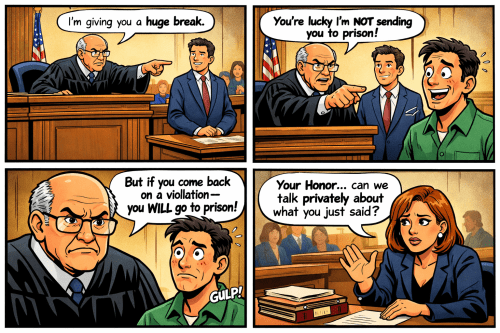
This new training update takes a close look at a surprisingly common (and understandable) judicial instinct: trying to impress upon a defendant the seriousness of probation… and accidentally going a step too far. As the Minnesota Supreme Court made clear in State v. Finch, that one step can have real consequences, including disqualification of the judge from a future proceeding.
In this update, I break down:
• The one statement that crosses the line • Why the Austin analysis makes that statement improper • How this issue typically arises in real courtrooms (with examples we’ve all seen) • The 4 key takeaways from Finch every judge and attorney should know • A simple, practical way to fix the problem if it happens in your courtroom
And—true to form—you’ll also find a visual illustration that captures the moment perfectly (and may feel just a little too familiar).
This is one of those issues that is easy to overlook—but once you see it clearly, you’ll never miss it again.
As always, I hope you find this both helpful in your practice and useful in the courtroom. If it resonates with you, please feel free to share it with colleagues who might benefit.
Warm regards,
Alan F. Pendleton Of Counsel, Martine Law Firm Director of Mentorship and Education Former District Court Judge Minnesota Judicial Training & Education Blog
Subject: New Training Update: State v. Lorsung — “Reasonable Suspicion” After the Minnesota Supreme Court’s Latest DWI Decision.
Dear Colleagues,
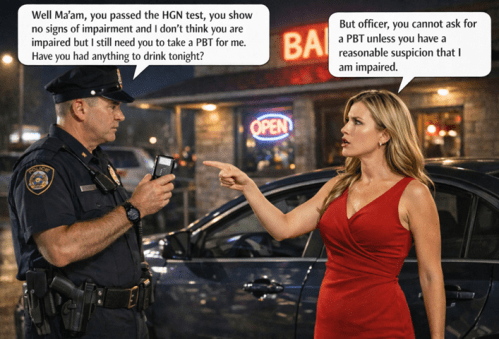
Last month, the Minnesota Supreme Court issued an important decision in State v. Lorsung, clarifying what constitutes reasonable suspicion for an officer to request a preliminary breath test (PBT) during a DWI investigation.
The ruling may surprise many practitioners. In Lorsung, the driver admitted to drinking three beers but displayed no classic signs of impairment, spoke clearly, balanced normally, and even passed the HGN test with zero clues. The officer himself believed the driver did not appear impaired. Yet the Court still concluded that the officer had reasonable suspicion to request a PBT.
The decision significantly reshapes how courts will evaluate reasonable suspicion in DWI investigations. As the Court explains, the absence of traditional indicia of impairment — and even satisfactory roadside performance — may weaken suspicion but does not necessarily eliminate it unless the known facts “conclusively negate” the possibility of impairment.
This training update examines the Court’s reasoning, breaks down the case using the FIRAC method, and highlights several key takeaways that will directly affect suppression litigation, roadside investigations, and client counseling in DWI cases moving forward.
As always, I hope you find the update helpful. If you believe others in your office or professional network would benefit from it, please feel free to forward it along.
Warm regards,
Alan F. Pendleton Of Counsel, Martine Law Firm Director of Mentorship and Education Former District Court Judge Minnesota Judicial Training & Education Blog
SUBJECT: Training Update 26-03 – Substitute Public Defender Requests: Avoiding Reversible Error
Colleagues,
I have just posted a new Minnesota Judicial Training Update (26-03) addressing a situation every judge and criminal practitioner eventually encounters:
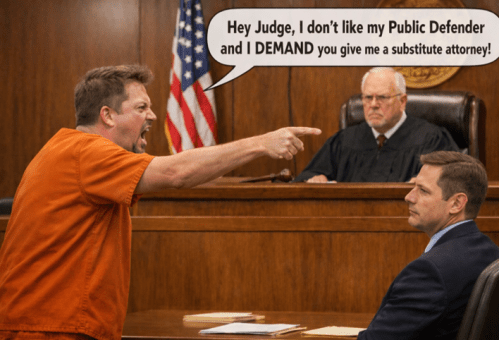
QUESTION: When a Defendant demands a new public defender in the middle of a criminal case, what is the trial judge legally required to do — and what common mistakes can create reversible error?
These moments often arise unexpectedly — usually at emotionally charged hearings — and they present real risk for reversible error if the court responds too quickly or relies on common but incorrect assumptions about substitute counsel requests.
This update provides a clear, practical framework designed for real courtroom use, including:
The three general rules that always apply under Minnesota law
What a judge should never say when a defendant requests new counsel
A structured three-step approach for handling the request on the record
The “searching inquiry” standard explained in practical terms
A sample judicial findings script that can be adapted immediately
The goal is simple: help judges and attorneys create a clean, reviewable record while maintaining courtroom control and protecting the integrity of the attorney-client relationship.
If you regularly handle criminal cases — whether as judge, prosecutor, or defense counsel — I think you will find this update both practical and immediately usable.
SUBJECT: New Training Update: Out-of-State Convictions — A Sentencing Trap You Can’t Ignore
Dear Colleagues,
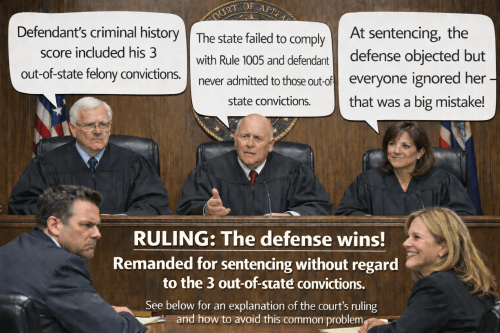
I’m sharing a new Martine Law Training Update addressing a deceptively common — and highly consequential — sentencing issue: how out-of-state convictions may (and may not) be used when calculating a defendant’s criminal history score.
In State v. Johnson(Minn. App. Jan. 20, 2026), the Court of Appeals makes clear that relying on a PSI alone to establish out-of-state convictions is a legal landmine. The case also delivers a critical lesson with real-world consequences: whether defense counsel objected at sentencing directly affected the remedy on appeal — including whether the State got a second chance to fix the record.
This update breaks down:
What Minn. R. Evid. 1005 requires (and what it doesn’t),
Why sentencing is an evidentiary determination, not a ministerial step,
How a single objection — or silence — can preserve or destroy appellate leverage,
Practical best practices for prosecutors, defense attorneys, and judges.
If you handle felony sentencing, review PSIs, advise clients at plea hearings, or preside over criminal cases, this is essential reading. I encourage you to read it, download it, and share it with colleagues who may not realize how high the stakes are until it’s too late.
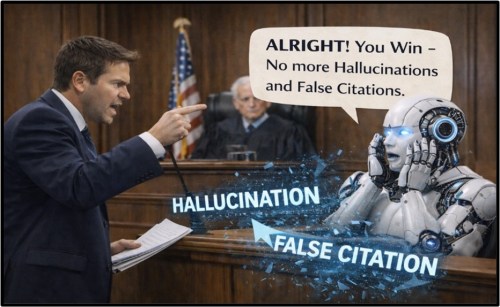
Artificial intelligence is now a routine part of legal research—but courts are making it equally clear that delegating judgment to AI is not an option. Sanctions, fee-shifting, disciplinary referrals, and reputational damage are no longer theoretical risks when hallucinated cases or fake citations find their way into filings.
The problem is not that AI is “too powerful.” The problem is that it must be supervised like any untested expert witness.
Martine Law Firm Training Update 26-01 introduces a simple, courtroom-tested solution:
Cross-Examine the AI before you rely on it or cite it.
This update provides a practical, lawyer-friendly framework for using AI safely and effectively in legal research, including:
A three-phase protocol (Prepare → Interrogate → Verify) for supervising AI-assisted research
A cross-examination checklist to expose uncertainty, weak assumptions, and fabricated authority
Ready-to-copy prompts that force reasoning, demand sources, and build a real verification pathway
Clear guidance on why this is now an ethics and competence issue, not merely a best practice
Used properly, AI can function like a fast, tireless junior associate. Used improperly, it can become a professional liability. This update is designed to help you capture the speed benefits of AI—without inheriting polished nonsense.
If you find this update helpful, please consider forwarding it to colleagues or staff who may benefit from it. And if you haven’t already, visit the Minnesota Judicial Training and Education Website to subscribe and receive future updates directly.
Special Thanks to Martine Law attorneys Rhiley O’Rourke, Cynthia Smith, Lizzy Cavanaugh, Tyler Martin, Ariana Wright, Dr. Charlene Evans-Smith, and Makayla Stromgen (certified student attorney) for generously contributing their insight and expertise to this update.
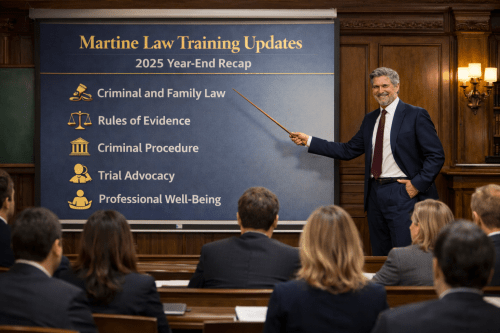
Martine Law Training Updates will continue to focus on key areas of litigation, including Criminal and Family Law, Evidence, Procedure, and Trial Advocacy. With a subscriber base of more than 4,000 attorneys, judges, and legal professionals, these updates reflect our firm’s commitment to the belief that Legal Education is the Heart of the Judiciary.
Warm regards, Alan F. Pendleton Of Counsel, Martine Law Firm Director of Mentorship and Education Former District Court Judge
SUBJECT: Martine Law Training Updates – Complete Recap (May–December 2025)
Dear Colleagues,
In the fast-paced worlds of criminal and family law, staying current on legal developments, courtroom procedure, and practical advocacy tools is essential. Since May 2025, the Martine Law Firm has issued eleven training updates covering core areas of Criminal Law, Family Law, Evidence, Procedure, Trial Advocacy, and Professional Well-being.
With new attorneys, judges, and legal professionals joining our distribution list each month, this recap is intended to provide a single, consolidated reference to all eleven updates issued between May and December 2025. Each update is also available on the Minnesota Judicial Training and Education Website. The most recent updates appear on the home page, while older updates are organized in a subject-matter index, table of contents, and searchable keyword index.
1. Training Update 25-2 (April 27, 2025) Title: Hearsay v. Non-Hearsay: The Fool-Proof Hearsay Test This update introduces a three-step analytical test for determining whether an out-of-court statement is hearsay, beginning with the correct threshold question before turning to exceptions. It also explains the six categories of Rule 801(d) non-hearsay statements with practical examples.
Why it matters: Proper hearsay analysis is foundational to trial practice and essential to avoiding evidentiary error.
2. Training Update 25-3 (June 4, 2025) Title: Crawford v. Washington and the Hearsay Testimonial Rule A follow-up to Update 25-2, this update explains testimonial hearsay under Crawford, Davis, and Krasky, and provides a four-part flowchart and a primary-purpose checklist.
Why it matters: Recognizing testimonial hearsay violations is critical to protecting Sixth Amendment confrontation rights and preserving issues for appeal.
3. Training Update 25-4 (June 22, 2025) Title: Marijuana Odor & Warrantless Vehicle Searches This update analyzes State v. Torgerson (2023) and M.S. 626.223, clarifying that the odor of marijuana alone does not justify a vehicle search. It also provides a practical overview of Minnesota’s marijuana reform laws and open-container statute.
Why it matters: Attorneys must know what conduct is lawful versus criminal to effectively challenge vehicle searches and suppress evidence.
4. Training Update 25-5 (July 7, 2025) Title: Family Law Motions – Ten Basic Rules This foundational update outlines 10 essential rules governing family law motion practice, including service deadlines, affidavit limits, requests for oral testimony, and the 2024 expedited parenting-time hearing requirement under M.S. 518.131.
Why it matters: Failure to follow basic motion rules can result in denied hearings, adverse rulings, and avoidable professional setbacks.
5. Training Update 25-6 (July 14, 2025) Title: Dimler Amendment – Keeping Speeding Tickets Off the Driving Record This update explains the Dimler Amendment (M.S. 171.12, subd. 6) and provides practical strategies for amending low-level speeding violations so they do not appear on a client’s DPS driving record.
Why it matters: Proper application of Dimler can protect clients from insurance consequences and provide leverage in traffic negotiations.
6. Training Update 25-7 (July 21, 2025) Title: Alford Pleas – A Three-Step Guide for Making a Valid Record This update provides a step-by-step guide and in-court script for accepting an Alford plea, ensuring compliance with State v. Theis and related case law.
Why it matters: Alford pleas are closely scrutinized on appeal. A clean record is essential to avoid reversal.
7. Training Update 25-8 (July 28, 2025) Title: The Power of Gratitude: Transforming the Lives and Practices of Attorneys and Judges Addressing the mental-health challenges of the legal profession, this update introduces gratitude as a science-based tool for resilience, perspective, and long-term professional sustainability.
Why it matters: Effective advocacy depends on healthy, resilient lawyers and judges.
8. Training Update 25-9 (August 18, 2025) Title: Prosecutorial Misconduct – The 15 Most Common Categories This update introduces a comprehensive framework that identifies and explains the 15 most common categories of prosecutorial misconduct, with practical examples and guidance on recognizing misconduct in real time and preserving the record.
Why it matters: Properly identified and preserved misconduct can lead to reversals, new trials, or sentencing relief.
9. Training Update 25-10 (November 24, 2025) Title: Judicial & Legal Writing – The Number One Rule for Improvement = CUTTING This update distills effective legal writing down to a single principle: cutting unnecessary words. Using judge-driven examples, it shows how clarity and persuasion improve when verbosity is eliminated.
Why it matters: Judges consistently identify verbosity as a top problem in written submissions.
10. Training Update 25-11 (December 4, 2025) Title: Warrantless Arrests & Detentions – The 36- and 48-Hour Rules Designed as a quick reference guide, this update explains when and how the 36- and 48-hour rules apply following warrantless arrests, including time-calculation charts and common pitfalls.
Why it matters: Violations can result in unlawful detention, release, or suppression issues if identified in time.
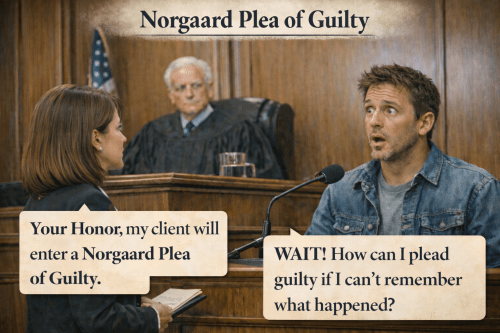
11. Training Update 25-12 (December 29, 2025) Title: Norgaard Plea of Guilty – Three Steps to Making a Proper Record This update provides a complete procedural guide and in-court script for accepting a Norgaard plea when a defendant cannot recall the facts due to intoxication or amnesia.
Why it matters: Improperly accepted Norgaard pleas are vulnerable on appeal.
Want to search for past topics? Use the search bar, the Table of Contents, or the Subject Matter Index. New to our list? Welcome aboard — and thank you for your commitment to excellence in legal practice.
If you find this recap helpful, please consider forwarding it to colleagues or staff who may benefit. And if you have not already, visit the Minnesota Judicial Training and Education Website to subscribe and receive future updates directly.
Special thanks to the Martine Law attorneys and Paralegals who generously contributed their insight and expertise to all past training updates.
Martine Law Training Updates will continue to focus on key areas of litigation, including Criminal and Family Law, Evidence and Procedure, and Trial Advocacy. With a subscriber base approaching 4,000 attorneys, judges, and legal professionals, these updates reflect our firm’s belief that legal education is the soul of the judiciary.
Warm regards, Alan F. Pendleton Of Counsel, Martine Law Firm Director of Mentorship and Education Former District Court Judge
Are you confident your Minnesota “unable-to-recall” guilty pleas would survive appellate review?
A Norgaard plea applies when a defendant wants to plead guilty (often for a plea bargain) but can’t recall the events due to intoxication or amnesia—and unlike an Alford plea, the defendant is not claiming innocence.
In this Martine Law Training Update, I break the procedure down into a practical three-step checklist and provide a ready-to-use in-court script that tracks the Norgaard Addendum (Rule 15, Appendix H)—so judges, prosecutors, and defense attorneys can make a complete record in real time.
👉 Click below for a print-ready copy of Training Update #25-12 (and keep the in-court script handy for your next plea hearing). Martine Law Training Update #25-12
Attached is our newest Martine Law Training Update, titled: “WARRANTLESS ARRESTS & DETENTIONS: 36 & 48 Hour Rules”
This update focuses on one of the most fundamental — and often misunderstood — aspects of criminal procedure: Minnesota’s 36- and 48-hour rules following an adult defendant’s arrest and continued detention. These rules are not technicalities; they are core constitutional safeguards that every judge and attorney should be able to calculate confidently and explain clearly to clients, law enforcement, and judicial officers.
This update is designed as a “Quick Attorney Reference Guide” and breaks the topic down into three practical questions:
(1) What is the 36-hour rule, and how is the time computed for warrantless arrests vs. arrests on a complaint/warrant?
(2) What is the 48-hour rule under County of Riverside v. McLaughlin and Minn. R. Crim. P. 4.03, and how does it interact with the 36-hour rule?
(3) What are the potential remedies when either rule is violated, including how the Wiberg factors and burdens of proof apply?
To help attorneys quickly calculate the 36- and 48-hour timeframes, this update includes easy-to-read visual charts that walk through real-world arrest scenarios day by day, making the 36- and 48-hour timing questions easy to see at a glance.
My hope is that you will review the attached update, print it or save it where you can reach it quickly, and consider sharing it with colleagues who handle bail, first appearances, or omnibus issues. A solid grasp of the 36- and 48-hour rules not only protects defendants’ rights but also helps judges and practitioners avoid potential violations that can derail otherwise strong cases.
As always, I welcome your comments, questions, and suggestions for future topics.
Special Thanks to Martine Law attorneys Tyler Martin, Abbey Rostamo, Kalen Best, Jude Jaber, Lizzy Cavanaugh, and Bruno Netto for generously contributing their insight and expertise to this update.
Martine Law Training Updates will continue to focus on key areas of litigation, including Criminal and Family Law, Evidence and Procedure, and Trial Advocacy. With a subscriber base of more than 4,000 attorneys, judges, and legal professionals, these updates reflect our firm’s commitment to the belief that Legal Education is the Heart of the Judiciary.
Warm regards, Alan F. Pendleton Of Counsel, Martine Law Firm Director of Mentorship and Education Former District Court Judge
Attached is our newest Martine Law Training Update, titled: “JUDICIAL & LEGAL WRITING: The Number One Rule for Improvement = CUTTING.”
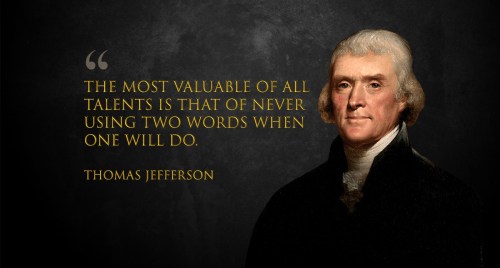
There are many books and articles dedicated to improving legal writing. Unfortunately, in many of these materials, you need an English degree to understand anything past the first paragraph. There is, however, a simple way to dramatically improve any style of legal writing that has nothing to do with dangling participles or misuse of pronouns, etc. Cutting unnecessary words is key to improving your writing.
Judges, attorneys, and other legal practitioners say the same thing about written legal submissions: they are too long. Most “legal writing” resources respond with lectures on grammar, style guides, and terminology that nobody has time to wade through. This Training Update takes a different approach. It focuses on one simple rule that will immediately improve every brief, motion, and email you write: cut unnecessary words.
Drawing on my experience reading thousands of briefs, motions, and emails from attorneys, I walk through concrete, before-and-after examples showing how to turn a bloated paragraph into something short, clear, and persuasive. The Update then breaks legal writing down into three practical levels—the sentence, the paragraph, and the final product—and gives you specific, easy-to-use techniques for each.
If you want your next submission to be easier for a judge to read, understand, and rule on, I encourage you to take a few minutes to read the full Training Update and share it with your colleagues and staff. A modest investment of time now will pay off in every brief you file going forward.
Martine Law Training Updates will continue to focus on key areas of litigation, including Criminal and Family Law, Evidence and Procedure, and Trial Advocacy. With a subscriber base of nearly 4,000 attorneys, judges, and legal professionals, these updates reflect our firm’s commitment to the belief that Legal Education is the Heart of the Judiciary.
Warm regards, Alan F. Pendleton Of Counsel, Martine Law Firm Director of Mentorship and Education Former District Court Judge
Attached is our newest Martine Law Training Update, titled: “Prosecutorial Misconduct: 15 Categories Every Attorney and Judge Should Recognize and Avoid”
This is one of the most comprehensive training updates I have produced to date. At 23 pages, it is designed not only as an informative resource but also as a statewide training tool for prosecutors, defense attorneys, and judges.
Although this update is titled Prosecutorial Misconduct, the focus is not on labels but on impact. Whether the conduct is characterized as error or misconduct matters less than the effect, because either, when serious enough, can deprive a defendant of a fair trial. Misconduct implies a deliberate or reckless violation; error may reflect an honest mistake. But both threaten the same outcome: injustice.
For that reason, this update does not attempt to parse whether a particular instance should be labeled “misconduct” or “error.” That distinction is best left to the appellate courts. Our focus here is practical: identifying improper prosecutorial conduct in all its forms so trial attorneys can recognize it, object to it, and preserve the issue for review.
The deeper concern, and the reason this update was created, is that these problems are not new. For decades, the Minnesota Supreme Court has made clear that prosecutors are not simply advocates seeking victory, but officers of justice with a duty to safeguard fairness—even when doing so weakens the State’s case. As the Court has long reminded us: “The prosecutor’s interest in a criminal prosecution is not that it shall win a case, but that justice shall be done.”
Despite this clear guidance, the same forms of misconduct continue to appear in trial records with troubling frequency. The problem is not a lack of clarity in the law—the rules are well-established—but a repeating generational pattern. Each new wave of prosecutors, eager to prove themselves in court, repeats the same mistakes made by those before them. The result is a predictable cycle: misconduct occurs, defense counsel objects, trial courts rule, and appellate courts issue yet another opinion restating principles that have been settled for decades. Most of these opinions today are nonprecedential, not because the law is unsettled, but because the errors are the same ones we have seen for generations.
This update is designed to help break that cycle. It sets out the 15 most common categories of prosecutorial misconduct seen in Minnesota courts, illustrated with leading cases, examples, and practice points. Together, these categories form a shared framework for all trial participants—prosecutors, defense attorneys, and judges—to recognize misconduct when it occurs, understand its significance, and take corrective action in real-time.
a) Prosecutors can use this update as an internal training tool to ensure advocacy remains effective while still within ethical boundaries.
b)Defense attorneys can use it to recognize misconduct as it occurs, object promptly, and preserve a clean record for appeal.
c) Judges can use it to guide intervention, remembering that the Minnesota Supreme Court has made clear that trial courts also bear responsibility for curbing misconduct—even when counsel fails to object.
The 15 Categories of Misconduct Covered in this Update:
Shifting the Burden of Proof
Injecting Issues Broader Than Guilt or Innocence
Accusing Defendant of Tailoring Testimony
Asking “Were They Lying” Questions
Eliciting Inadmissible Evidence
Misstating the Burden of Proof
Misstating the Presumption of Innocence
Expressing a Personal Opinion – Vouching
Belittling the Defense
Inflaming the Passions of the Jury
Commenting on a Defendant’s Failure to Testify
Misusing Spreigl Evidence
Speculating About Events Absent a Factual Basis
Eliciting Improper or Highly Prejudicial Testimony
Injecting Self into Proceedings: “I,” “We,” “Me”
Importantly, these ethical limits do not require prosecutors to be bland, formulaic, or restrained in their passion. Minnesota courts have repeatedly affirmed that vigorous advocacy is entirely proper—so long as it remains grounded in admissible evidence and accurate law.
I encourage you to read and share this update with your colleagues. Whether you are a prosecutor, defense attorney, or judge, this resource is designed to promote more effective advocacy, fewer repeated mistakes, and a stronger commitment to justice and fairness in every courtroom.
Special Thanks to Martine Law attorneys Luke McClure, Tyler Martin, Abbey Rostamo, and Kalen Best for generously contributing their insight and expertise to this update.
Acknowledgment: This update builds upon training materials first developed in 2005 by then–Assistant Hennepin County Attorneys Michael K. Walz, Jean E. Burdorf, and David C. Brown. Their work laid an important foundation for understanding the nature and scope of prosecutorial misconduct in Minnesota.
Martine Law Training Updates will continue to focus on key areas of litigation, including Criminal and Family Law, Evidence and Procedure, and Trial Advocacy. With a subscriber base of nearly 4,000 attorneys, judges, and legal professionals, these updates reflect our firm’s commitment to the belief that Legal Education is the Heart of the Judiciary.
Warm regards, Alan F. Pendleton Of Counsel, Martine Law Firm Director of Mentorship and Education Former District Court Judge alan@xmartinelaw.com
Message From Site Manager Alan Pendleton (former district court judge)
This training site contains the complete repository of "Judicial Training Updates". Training Updates are designed to be short, concise, easy-to-read judicial tips that every judge and attorney should know.
Judicial Training Updates are listed under TABLE OF CONTENTS and SUBJECT MATTER INDEX above and CATEGORIES below. The five most recent Updates are posted to the left.
JUDICIAL RESOURCE LIBRARY: This Blog also serves as a one-stop judicial resource library with hyperlinks to numerous legal research and reference sites.
NATIONAL RECOGNITION: From a field of more than 2,000 legal blogs, the Minnesota Judicial Training & Education Blog placed second in the highly competitive education category of the Expert Institute's Best Legal Blog National Competition.
ADD YOUR EMAIL BELOW AND RECEIVE A NOTIFICATION WHENEVER A NEW UPDATE IS POSTED.



 MINNESOTA JUDICIAL TRAINING & EDUCATION BLOG