
SUBJECT: Martine Law Training Updates – Complete Recap (May–December 2025)
Dear Colleagues,
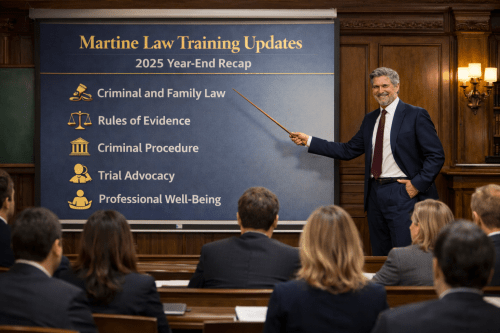
In the fast-paced worlds of criminal and family law, staying current on legal developments, courtroom procedure, and practical advocacy tools is essential. Since May 2025, the Martine Law Firm has issued eleven training updates covering core areas of Criminal Law, Family Law, Evidence, Procedure, Trial Advocacy, and Professional Well-being.
With new attorneys, judges, and legal professionals joining our distribution list each month, this recap is intended to provide a single, consolidated reference to all eleven updates issued between May and December 2025. Each update is also available on the Minnesota Judicial Training and Education Website. The most recent updates appear on the home page, while older updates are organized in a subject-matter index, table of contents, and searchable keyword index.
1. Training Update 25-2 (April 27, 2025)
Title: Hearsay v. Non-Hearsay: The Fool-Proof Hearsay Test
This update introduces a three-step analytical test for determining whether an out-of-court statement is hearsay, beginning with the correct threshold question before turning to exceptions. It also explains the six categories of Rule 801(d) non-hearsay statements with practical examples.
Why it matters: Proper hearsay analysis is foundational to trial practice and essential to avoiding evidentiary error.
2. Training Update 25-3 (June 4, 2025)
Title: Crawford v. Washington and the Hearsay Testimonial Rule
A follow-up to Update 25-2, this update explains testimonial hearsay under Crawford, Davis, and Krasky, and provides a four-part flowchart and a primary-purpose checklist.
Why it matters: Recognizing testimonial hearsay violations is critical to protecting Sixth Amendment confrontation rights and preserving issues for appeal.
3. Training Update 25-4 (June 22, 2025)
Title: Marijuana Odor & Warrantless Vehicle Searches
This update analyzes State v. Torgerson (2023) and M.S. 626.223, clarifying that the odor of marijuana alone does not justify a vehicle search. It also provides a practical overview of Minnesota’s marijuana reform laws and open-container statute.
Why it matters: Attorneys must know what conduct is lawful versus criminal to effectively challenge vehicle searches and suppress evidence.
4. Training Update 25-5 (July 7, 2025)
Title: Family Law Motions – Ten Basic Rules
This foundational update outlines 10 essential rules governing family law motion practice, including service deadlines, affidavit limits, requests for oral testimony, and the 2024 expedited parenting-time hearing requirement under M.S. 518.131.
Why it matters: Failure to follow basic motion rules can result in denied hearings, adverse rulings, and avoidable professional setbacks.
5. Training Update 25-6 (July 14, 2025)
Title: Dimler Amendment – Keeping Speeding Tickets Off the Driving Record
This update explains the Dimler Amendment (M.S. 171.12, subd. 6) and provides practical strategies for amending low-level speeding violations so they do not appear on a client’s DPS driving record.
Why it matters: Proper application of Dimler can protect clients from insurance consequences and provide leverage in traffic negotiations.
6. Training Update 25-7 (July 21, 2025)
Title: Alford Pleas – A Three-Step Guide for Making a Valid Record
This update provides a step-by-step guide and in-court script for accepting an Alford plea, ensuring compliance with State v. Theis and related case law.
Why it matters: Alford pleas are closely scrutinized on appeal. A clean record is essential to avoid reversal.
7. Training Update 25-8 (July 28, 2025)
Title: The Power of Gratitude: Transforming the Lives and Practices of Attorneys and Judges
Addressing the mental-health challenges of the legal profession, this update introduces gratitude as a science-based tool for resilience, perspective, and long-term professional sustainability.
Why it matters: Effective advocacy depends on healthy, resilient lawyers and judges.
8. Training Update 25-9 (August 18, 2025)
Title: Prosecutorial Misconduct – The 15 Most Common Categories
This update introduces a comprehensive framework that identifies and explains the 15 most common categories of prosecutorial misconduct, with practical examples and guidance on recognizing misconduct in real time and preserving the record.
Why it matters: Properly identified and preserved misconduct can lead to reversals, new trials, or sentencing relief.
9. Training Update 25-10 (November 24, 2025)
Title: Judicial & Legal Writing – The Number One Rule for Improvement = CUTTING
This update distills effective legal writing down to a single principle: cutting unnecessary words. Using judge-driven examples, it shows how clarity and persuasion improve when verbosity is eliminated.
Why it matters: Judges consistently identify verbosity as a top problem in written submissions.
10. Training Update 25-11 (December 4, 2025)
Title: Warrantless Arrests & Detentions – The 36- and 48-Hour Rules
Designed as a quick reference guide, this update explains when and how the 36- and 48-hour rules apply following warrantless arrests, including time-calculation charts and common pitfalls.
Why it matters: Violations can result in unlawful detention, release, or suppression issues if identified in time.
11. Training Update 25-12 (December 29, 2025)
Title: Norgaard Plea of Guilty – Three Steps to Making a Proper Record
This update provides a complete procedural guide and in-court script for accepting a Norgaard plea when a defendant cannot recall the facts due to intoxication or amnesia.
Why it matters: Improperly accepted Norgaard pleas are vulnerable on appeal.
If you missed any of the above updates, you can also access them at:
📚 Minnesota Judicial Training and Education Website
Want to search for past topics? Use the search bar, the Table of Contents, or the Subject Matter Index. New to our list? Welcome aboard — and thank you for your commitment to excellence in legal practice.
If you find this recap helpful, please consider forwarding it to colleagues or staff who may benefit. And if you have not already, visit the Minnesota Judicial Training and Education Website to subscribe and receive future updates directly.
Special thanks to the Martine Law attorneys and Paralegals who generously contributed their insight and expertise to all past training updates.
Martine Law Training Updates will continue to focus on key areas of litigation, including Criminal and Family Law, Evidence and Procedure, and Trial Advocacy. With a subscriber base approaching 4,000 attorneys, judges, and legal professionals, these updates reflect our firm’s belief that legal education is the soul of the judiciary.
Warm regards,
Alan F. Pendleton
Of Counsel, Martine Law Firm
Director of Mentorship and Education
Former District Court Judge
Discover more from MINNESOTA JUDICIAL TRAINING & EDUCATION BLOG
Subscribe to get the latest posts sent to your email.


 MINNESOTA JUDICIAL TRAINING & EDUCATION BLOG